
Why AI Agents Need More Than Just a Powerful LLM
AI Agent Architecture requires more than powerful LLMs. Discover how memory, tools, planning, and orchestration enable reliable AI agents.
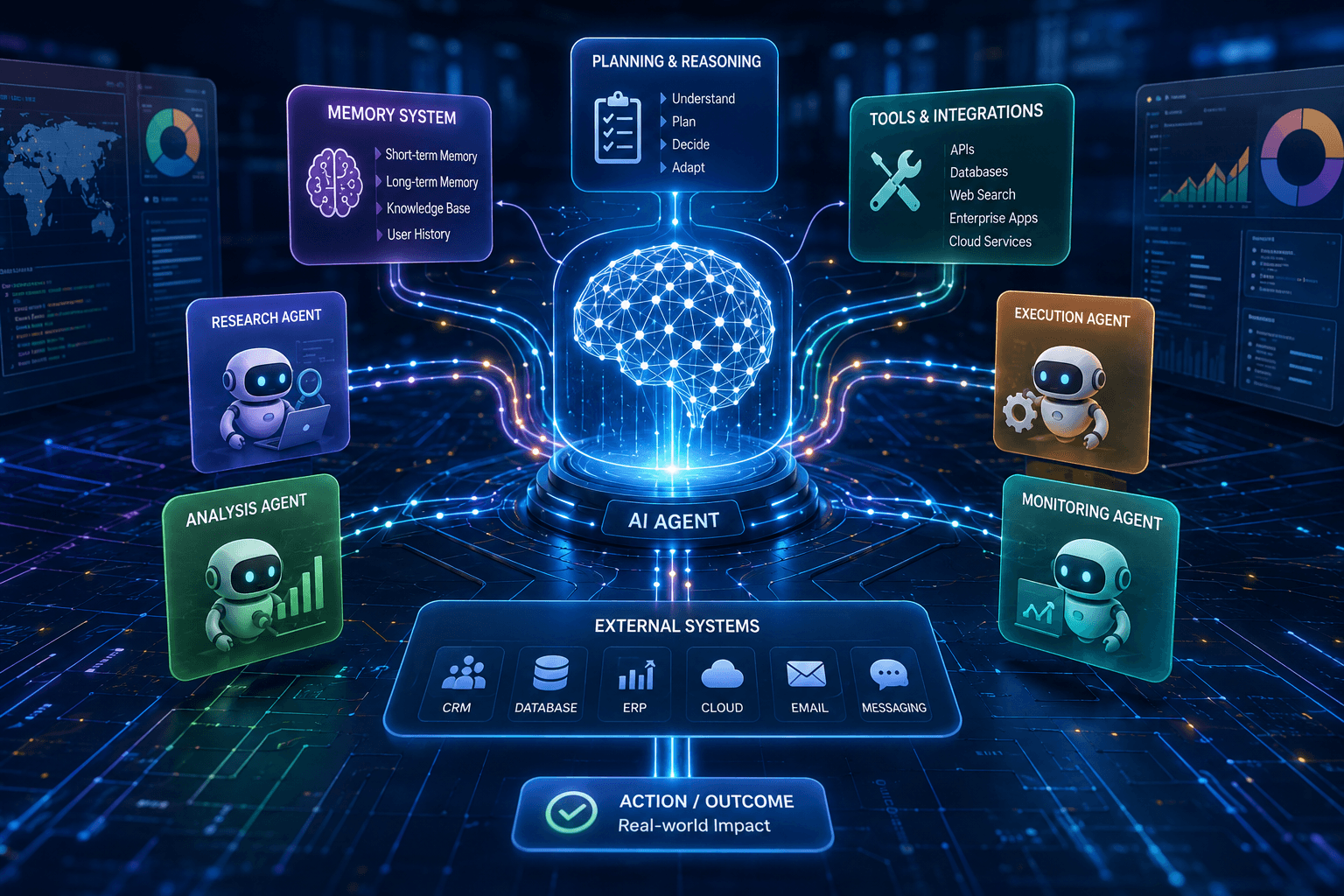
Artificial intelligence agents are moving beyond simple chat interfaces and becoming operational tools inside businesses. Companies are using them to automate workflows, analyze data, assist developers, and interact with customers. As adoption grows, developers are discovering that even the most capable Large Language Models (LLMs) cannot deliver these outcomes on their own.

The shift has placed greater attention on AI Agent Architecture, a framework that combines language models with memory systems, planning mechanisms, external tools, and execution layers. Although LLMs continue to serve as the reasoning engine in most AI models, developers are now looking at LLMs as one element of a larger architecture. This change is in recognition of the realization gained by the entire AI sector. An intelligent agent requires much more than simply the generation of accurate text.
AI Agent Architecture Addresses the Limits of Standalone Models
The Large Language Models have shown proficiency in content generation, coding help, and answering questions. However, the use of AI in organizations faces difficulties when shifting from tests to production.
One of the problems is related to the retention of context. The models are able to analyze information only within the frame of a certain context window. When the context window is exhausted, earlier information might not be considered when responding. The problem might occur when using applications that should maintain awareness of the user’s preferences, past interaction, or tasks.

The solution to this problem is provided by AI Agent Architecture through the introduction of memory layers for storing and recalling information outside the context window of the model. In addition to prompts, the agents can utilize structured knowledge while performing tasks.
Another issue is related to action execution. The language model is able to suggest performing a certain task but it cannot execute it without the access to other systems. The modern AI Agent Architecture solves this problem through the connection of agents to databases, APIs, software platforms, and enterprise applications.
Planning Systems Help Agents Handle Complex Objectives
Many processes in a business setting need multiple steps to be performed to accomplish the required objective. In case of a customer support request, it can entail getting information about accounts, evaluating the history of interaction, sending the reply and updating the database. Without planning, it becomes difficult for the AI to accomplish such a process efficiently.

Hence, the developers are implementing planning algorithms in the AI Agent Architecture. They allow the agent to break down the larger objective into smaller pieces, analyze the process and make any necessary corrections according to new circumstances.
The mechanism is similar to the process adopted by project managers while handling various tasks. Instead of performing all processes at once, the agent goes through various stages to achieve one particular objective.
Tool Integration Expands Agent Capabilities
Tool use has come to be a hallmark of contemporary AI Agent Architecture. Businesses increasingly require their AI agents not just to make suggestions, but also to carry out tasks.
A customer support agent can pull customer data from a CRM tool. A financial agent can analyze transaction data. A software development agent can access repositories, run tests, and look at code revisions. These actions rely on connections outside of the model itself.
Additionally, developers are building orchestration components which will allow models, memory, and tools to interact in a coordinated way. This will help agents to understand whether to pull information, perform a task, or how to deal with an unanticipated result.
Orchestration is fast becoming a regular part of AI Agent Architecture, not a bonus add-on.
Multi-Agent Systems Are Driving the Next Stage of Development
A lot of enterprises are shifting towards multi-agent architectures where responsibility is distributed among specialized AI agents. Companies do not have to depend upon a single system because there could be a research agent, an analysis agent, a compliance agent, and an execution agent.
Under such circumstances, every agent gets assigned some specific responsibility but works towards achieving a common goal. It is similar to a team of workers in an office who have different skill sets and work together on a project.

Moreover, the emergence of multi-agent systems is affecting the development of the AI Agent Architecture. There are frameworks that are being developed by companies which help in coordinating and communicating amongst agents while maintaining the security framework.
With the increasing use of AI, industry conversations are moving from model size to architecture designs. The future of autonomous systems might be dependent more on the development of the AI Agent Architecture than on language models.