
The Rise of AI Agents in DeFi as On-Chain Fund Managers
Explore how AI Agents in DeFi are transforming portfolio management, yield optimization, and autonomous on-chain investing.
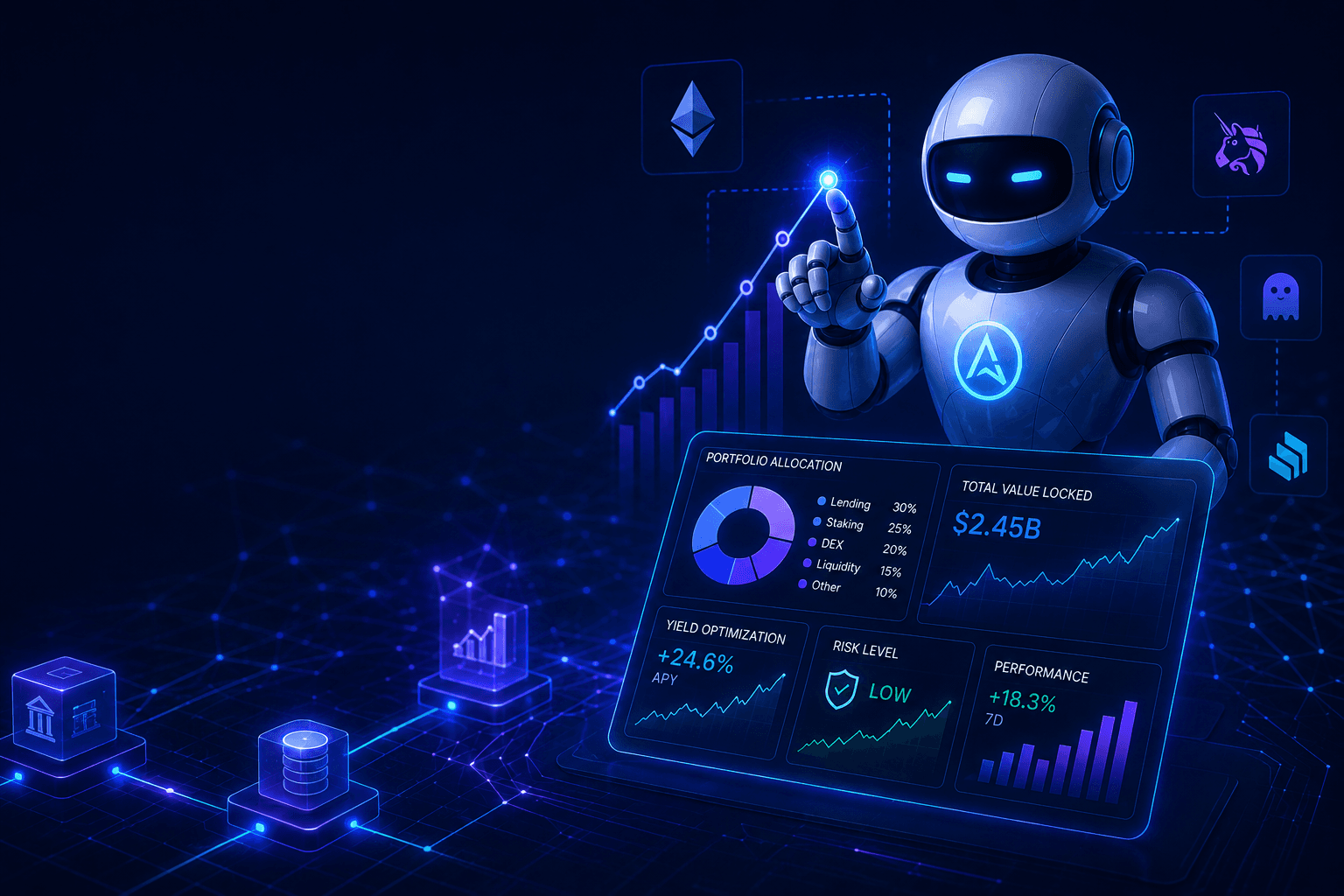
AI Agents in DeFi Transition from Experimental Software to Players in Decentralized Finance. Blockchain developers are creating automated solutions capable of conducting market analysis, allocating investments, performing transactions, and managing risks independently from human intervention.
The transition is linked to the development of automation processes in finance. Using AI and smart contracts, these solutions will be able to perform functions that usually require trading, analyzing or portfolio management. Despite the infancy of this approach, the high activity in the space shows that AI-driven fund management becomes a crucial part of decentralized finance.
AI Agents in DeFi Gain Ground Across Blockchain Markets
Decentralized finance technology has led to the emergence of a market that works on a 24/7 basis. Many lending protocols, decentralized exchanges, liquidity pools, and staking applications produce huge amounts of data constantly. In the context of that, for many players, it becomes harder and harder to observe all those possibilities manually.

Under these conditions, the need for AI Agents in DeFi arises. The thing is that while traditional trading robots work according to some predetermined rules, AI agents can assess the changes in circumstances and react appropriately. They analyze the blockchain data, recognize certain patterns and conduct transactions via smart contracts. That is why developers present these kinds of systems as autonomous financial systems rather than just trading applications.
Many projects are seeking for the ways to use AI agents in portfolio management, treasury management, and yield farming practices.
Autonomous Systems Take On Fund Management Roles
The traditional asset managers will evaluate the state of the market and then allocate the funds based on their research, performance, and risks. Developers try to mimic some aspects of such an approach by developing AI Agents in DeFi.
Such programs will be able to observe the interest rates, staking rewards, liquidity rewards, and other performance indicators of tokens in different protocols. Once the state of the market changes, the program will automatically readjust its portfolio. Afterward, smart contracts will execute those trades directly on the blockchain.

This process is similar to how the navigation software works, trying to find a faster route while the person is traveling. However, instead of monitoring traffic conditions, AI agents will analyze the state of digital assets.
Cross-chain operation of such agents becomes another field of interest. Some projects develop agents that would move assets between different blockchain ecosystems in order to maximize yield or minimize risks.
Risk Monitoring Becomes a Key Function
The topic of risk management has been considered one of the most popular applications of AI agents in DeFi. In particular, blockchain market conditions tend to fluctuate quickly, while people have a hard time watching their actions on different protocols.

To solve this problem, AI models consider the activity of wallets, transaction flows, liquidity flows, and volatility of the market. This means that their main goal is to recognize potential risks before losing any money. For instance, when an agent realizes that there is a drop of liquidity in a certain protocol, then it decreases its involvement in this protocol.
Developers see the implementation of AI agents in DeFi as an opportunity to improve the process of monitoring but not to substitute people with machines. This is because these models can analyze a huge amount of information much faster than any person would be able to do.
Nevertheless, the efficiency of such systems depends on both data quality and the precision of AI models.
Technical and Regulatory Questions Remain
Even with increasing popularity, AI Agents in DeFi still encounter a number of issues. Security risks of smart contracts are a major issue since agents rely on blockchain solutions for performing any kind of financial action. A single vulnerability may result in the exposure of the assets despite flawless performance of an artificial intelligence solution.
Another challenge related to AI is that of data integrity since all the data stored in blockchain is open, but AI has to be able to recognize valid actions from fake signals.
Moreover, regulators are examining how autonomous financial systems can fit into the current regulations framework.
At the moment, the industry remains to be developing through trial-and-error. With further development of blockchain technology and machine learning, AI Agents in DeFi become an increasingly prominent topic of discussions on the future of financial management.