
Why LLM Infrastructure Matters More Than Models
Discover why LLM infrastructure is becoming more important than model quality for scalability, cost control, performance, and reliability.
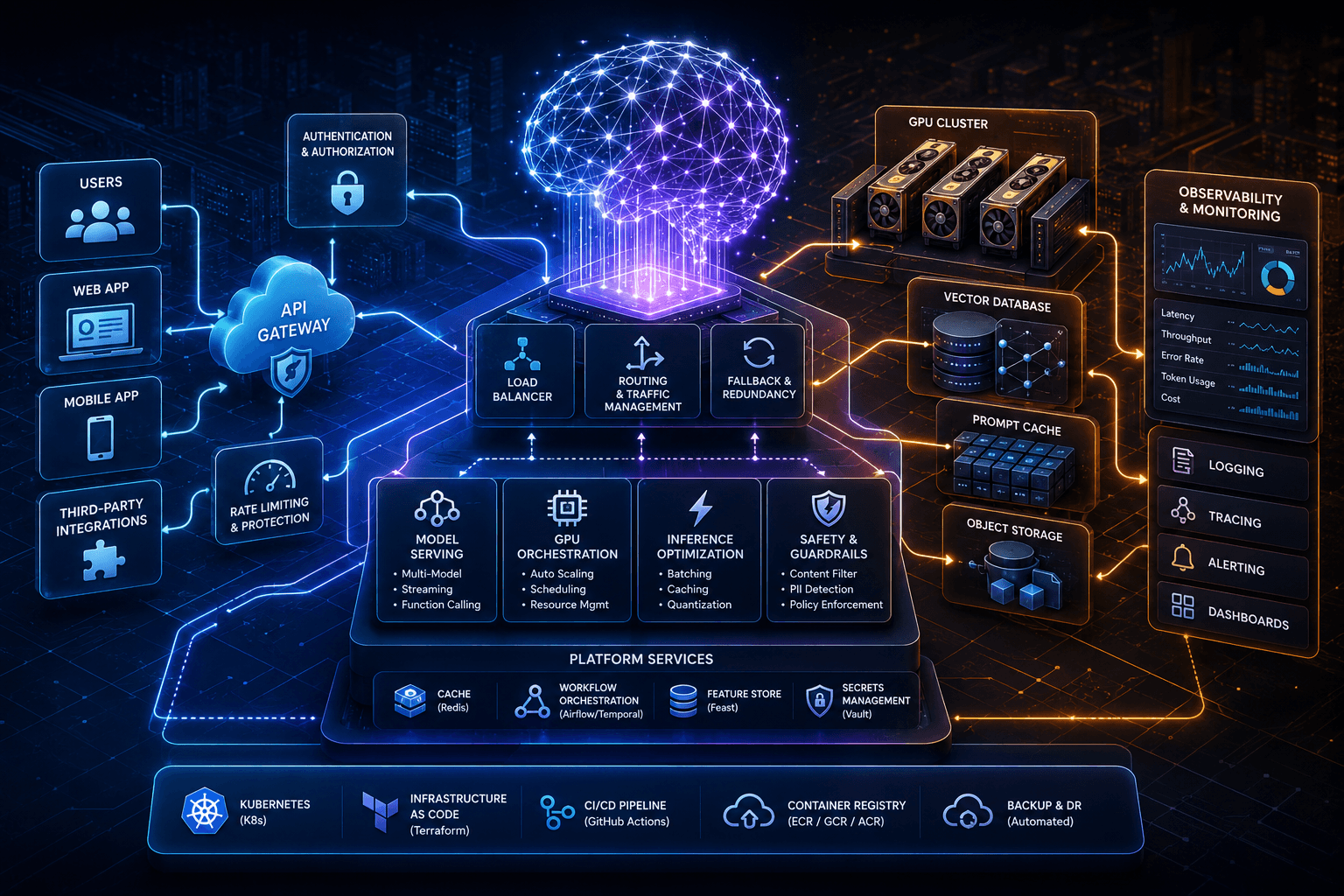
LLM infrastructure: AI innovation is moving into a new era where access to strong large language models is not restricted to a select few corporations anymore. With open-source models and API services, cutting-edge AI features are now easily accessible. Attention has now become focused on the infrastructure needed to run these models.
The options for organizations have now increased. The problem arises somewhere else. Speed, resource management, cost management, and reliability need to be ensured. These demands have placed LLM Infrastructure at the center of AI deployment strategies.

Why Model Quality Alone No Longer Creates an Advantage
For several years, the AI industry was concerned with developing bigger models with better capabilities. Metrics were important, and every new release of a model was widely publicized. Although model capability is one thing to consider, many companies now have to deal with problems that benchmarks cannot help with.
A language model may show good results during tests, but it does not necessarily mean that it will operate smoothly in production with all of its associated problems like latency issues, high inference costs, and unstable response time. The emergence of these concerns has made AI Infrastructure become more prominent among engineers.
The analogy may be found in modern transport systems. It makes little sense to develop a fast car without having infrastructure to support it.
LLM Inference Has Become the Main Engineering Challenge
Training of Large Language Models requires significant computing capabilities. However, organizations use more computing power to serve model responses rather than train them. It is called LLM Inference and takes place whenever an entity sends a prompt.

There are challenges associated with inference loads. Every new request uses GPU computing, memory, and bandwidth resources. If user requests increase, so do associated expenses. The main objective for engineering staff becomes the minimization of latency and quality preservation.
There are several solutions to this challenge. Request batching involves processing of multiple prompts using the same computing resources. Quantization decreases the size of a model due to less numerical precision. Caching allows keeping previous prompts’ results instead of processing them again.
The Core Components of Modern LLM Infrastructure
Production-grade LLM Infrastructure consists of multiple interconnected systems. Serving platforms handle request handling and workload distribution through available infrastructure. Meanwhile, GPU scheduling frameworks schedule computing power according to workload demands and requirements.

Vector-based databases facilitate the retrieval augmentation process of response creation by enabling application-level queries of external datasets prior to model response generation. Therefore, responses can become more relevant while minimizing dependency on training data only.
Observability frameworks have an important part to play as well. Latency, resource consumption, errors, and cost data help engineers detect bottlenecks and optimize system performance. Without this monitoring, managing large-scale AI solutions becomes impossible.
Infrastructure Will Shape the Next Stage of AI Adoption
Access to more potent models has made competition within the sphere of AI very different from what it was before. Access to potent models is now relatively easy, whereas efficiency remains the main distinguishing feature between efficient and ineffective deployment efforts.
Companies that create products based on AI technology should be able to achieve the right combination of speed, reliability, and affordability. This, however, is possible only when effective LLM Deployment procedures are put in place and scalable infrastructure designs developed.
As adoption spreads into more sectors, LLM Infrastructure will remain an important factor in determining organizations’ approaches to AI application deployment. From the perspective of engineers working on such initiatives, efficiency in model service may be even more crucial than the choice of models itself.