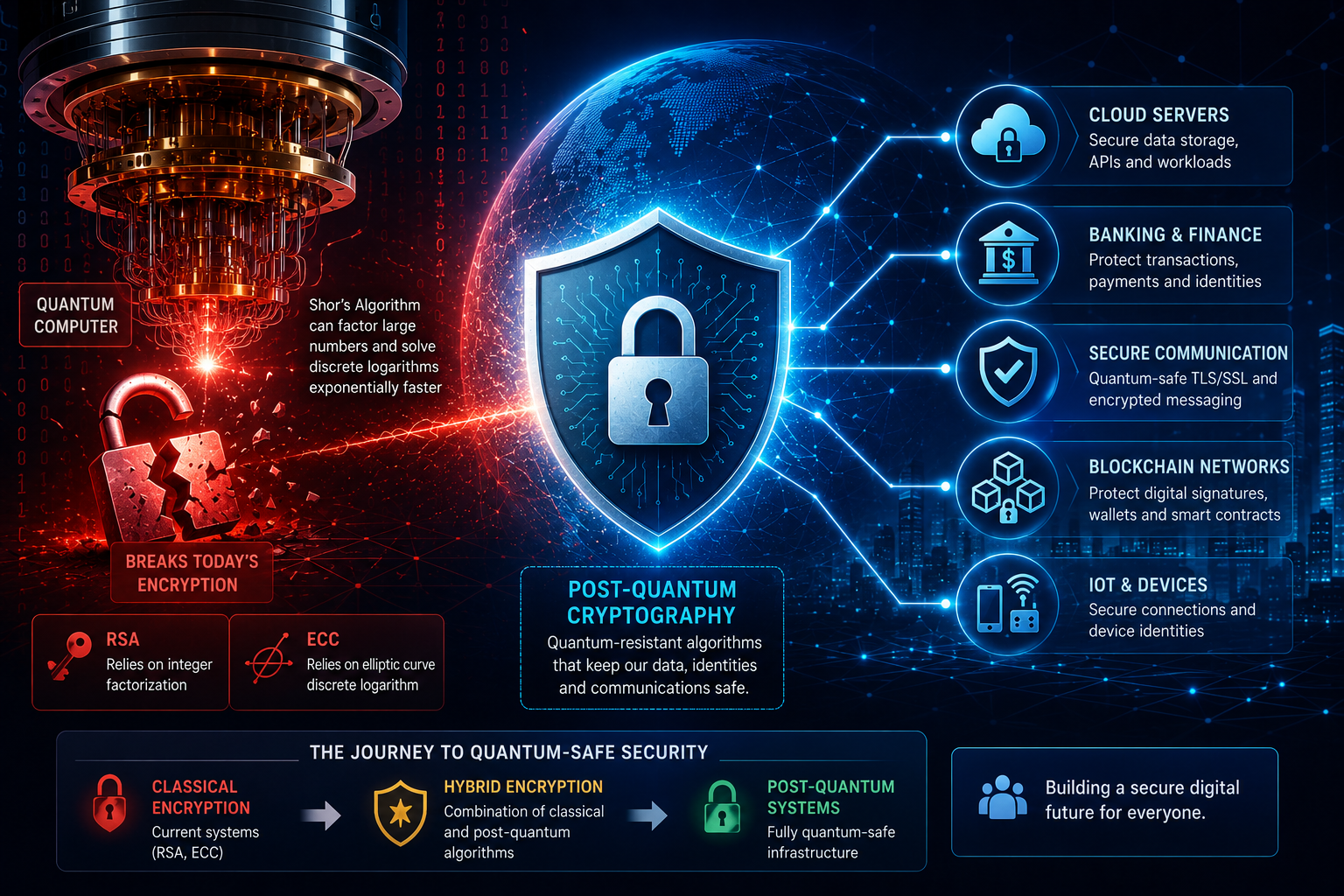

How does Post-Quantum Cryptography Stop Quantum Threats? Quantum computing research has continued unabated, and at the same time, cybersecurity professionals have started to brace themselves against the threats posed by encryption technologies. Researchers in cybersecurity, tech companies, and other bodies have pointed out that quantum computers pose a significant threat to popular encryption algorithms such as RSA and ECC. In view of this reality, there have been increased implementations of Post-Quantum Cryptography to protect future digital communication channels.
The National Institute of Standards and Technology (NIST) has spearheaded efforts to establish standards for quantum resistant encryption algorithms. Several cryptographic algorithms resistant to quantum systems have been adopted by the body as encryption standards. These standards will form the basis of cybersecurity debates within cloud architectures, blockchain, banking, and other enterprises.
How Quantum Computers Threaten Modern Encryption
The basis of modern cyber security is mathematics problems that cannot be solved by traditional computers in an efficient way. Such encryption algorithms include RSA, which is based on integer factorization, and ECC, which works on discrete logarithms. Traditional computers need considerable amounts of processing power and time to find solutions to such equations.
On the other hand, quantum computers are built in a different manner. Quantum computers use quantum bits, also known as qubits, allowing multiple states to be processed simultaneously. Many scientists suggest that Shor’s Algorithm poses a serious threat to current cryptographic methods since it enables quantum computers to solve the factorization problem much faster than classical computers do.
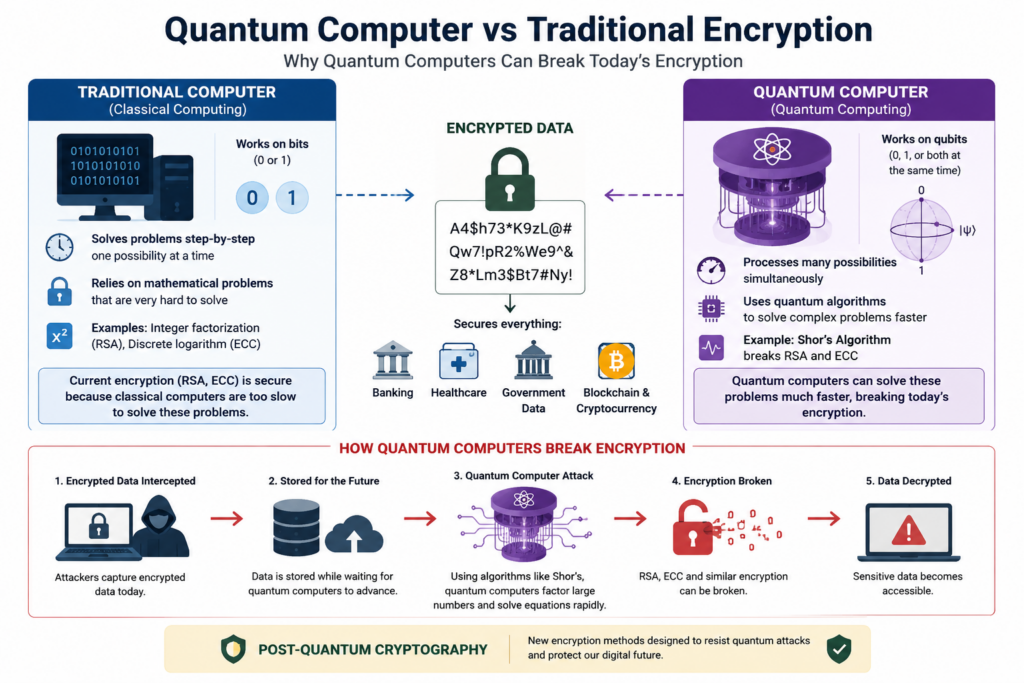
In addition, experts have proposed the idea of “harvest now, decrypt later.” In this case, malicious actors collect encrypted information at the present moment but postpone decryption until quantum computing technology advances enough to break the codes. This could lead to breaches of financial transactions, patients’ data from healthcare facilities, classified governmental information, as well as cryptocurrencies stored in blockchain wallets.
IBM, Google, and Microsoft companies have invested in researching quantum computing technology. Therefore, more attention has been paid to Post-Quantum Cryptography lately.
Why RSA and ECC Could Fail Against Quantum Systems
Both RSA and ECC continue to be critical elements of internet security systems. They are used by websites, virtual private networks (VPNs), instant message applications, and online payment solutions to authenticate users and securely transfer data. Nevertheless, quantum computing research poses questions regarding the viability of the above technologies in the future.
The security of classical encryption protocols is based on the computational complexity of calculations. RSA involves large prime numbers, whereas ECC utilizes elliptic curve equations. It would take many years for a classical computer to revert these computations. On the contrary, a quantum system might significantly speed up the decryption.
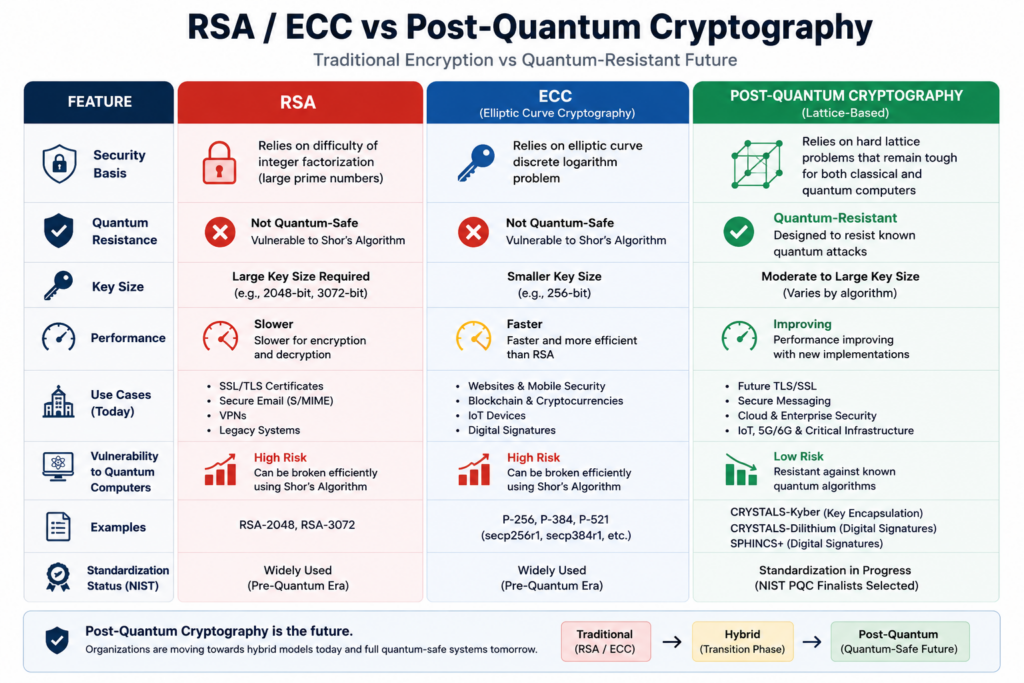
Post-Quantum Cryptography represents mathematical concepts which cannot be cracked by a quantum computer. Many post-quantum systems use lattice-based cryptography. Contrary to RSA and ECC, they are founded on mathematical problems of geometry that are complex for classical computers.
Among those algorithms selected by NIST for standardization were CRYSTALS-Kyber and CRYSTALS-Dilithium. At present, cybersecurity specialists began implementing the post-quantum encryption algorithms in enterprise environments. Programmers also developed hybrid encryption approaches that will combine traditional encryption models with new systems during the transitional period.
How Post-Quantum Cryptography Works in Practice
As stated by Post-Quantum Cryptography, it is all about finding ways to replace those encryption algorithms that are vulnerable to attacks and at the same time making sure that we do not interfere with Internet infrastructures.
One of the approaches to implementing Post-Quantum Cryptography relies on lattice cryptography. As the name implies, lattice cryptography makes use of lattices in multidimensions. It generates difficult mathematical problems that even the quantum computers cannot solve, according to current understanding.
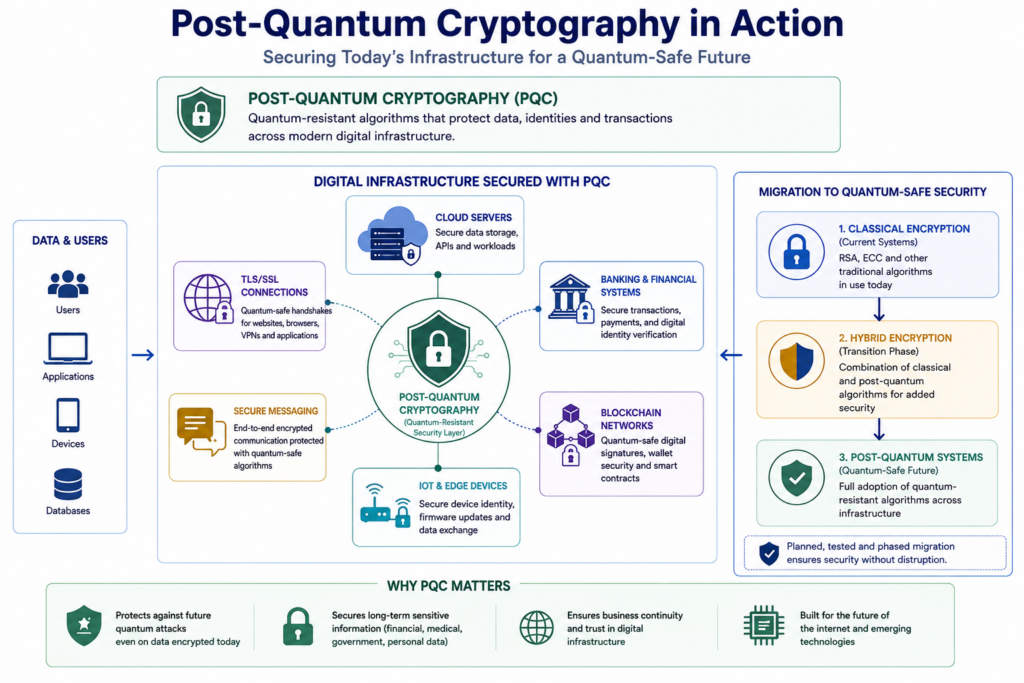
It has already become possible to implement Post-Quantum Cryptography in TLS protocols, secure messaging, and blockchain technology. Blockchain enthusiasts have also explored possibilities of quantum computers affecting wallet security and their ability to sign off transactions.
Cloud computing vendors and enterprise cybersecurity companies have also widened the scope of their migration plans. In order to plan a successful migration to Post-Quantum Cryptography, companies need to audit their cryptographic inventory first.
Industries Preparing for Quantum-Safe Security
There has been rapid progress in discussions regarding security architectures that could withstand quantum computers. Information that is stored over an extended period of time becomes more vulnerable if quantum systems develop faster than anticipated.
Encrypted transactions and authentication processes are used daily in banking operations. Patient data is secured in healthcare organizations using cryptographic mechanisms that might need to be upgraded in the future. Telecom firms also utilize cryptography to ensure network communication security.
Further studies of quantum-resistant encryption techniques are currently underway for blockchain applications. Some specialists have mentioned that quantum attacks could potentially pose future threats to wallets using exposed public keys. The team of scientists is exploring new signature mechanisms suitable for quantum cryptography.
Research in Post-Quantum Cryptography is still ongoing in cybersecurity space. Scientists keep researching different properties such as efficiency and scalability of various algorithms as well as their compatibility with modern infrastructure. With further advances in quantum computing, organizations would probably invest heavily in quantum-resistant encryption techniques.