
Autonomous Agents: The New Interface for Software
Discover how autonomous agents are transforming software from chatbots into digital workers and creating new opportunities for tech careers.
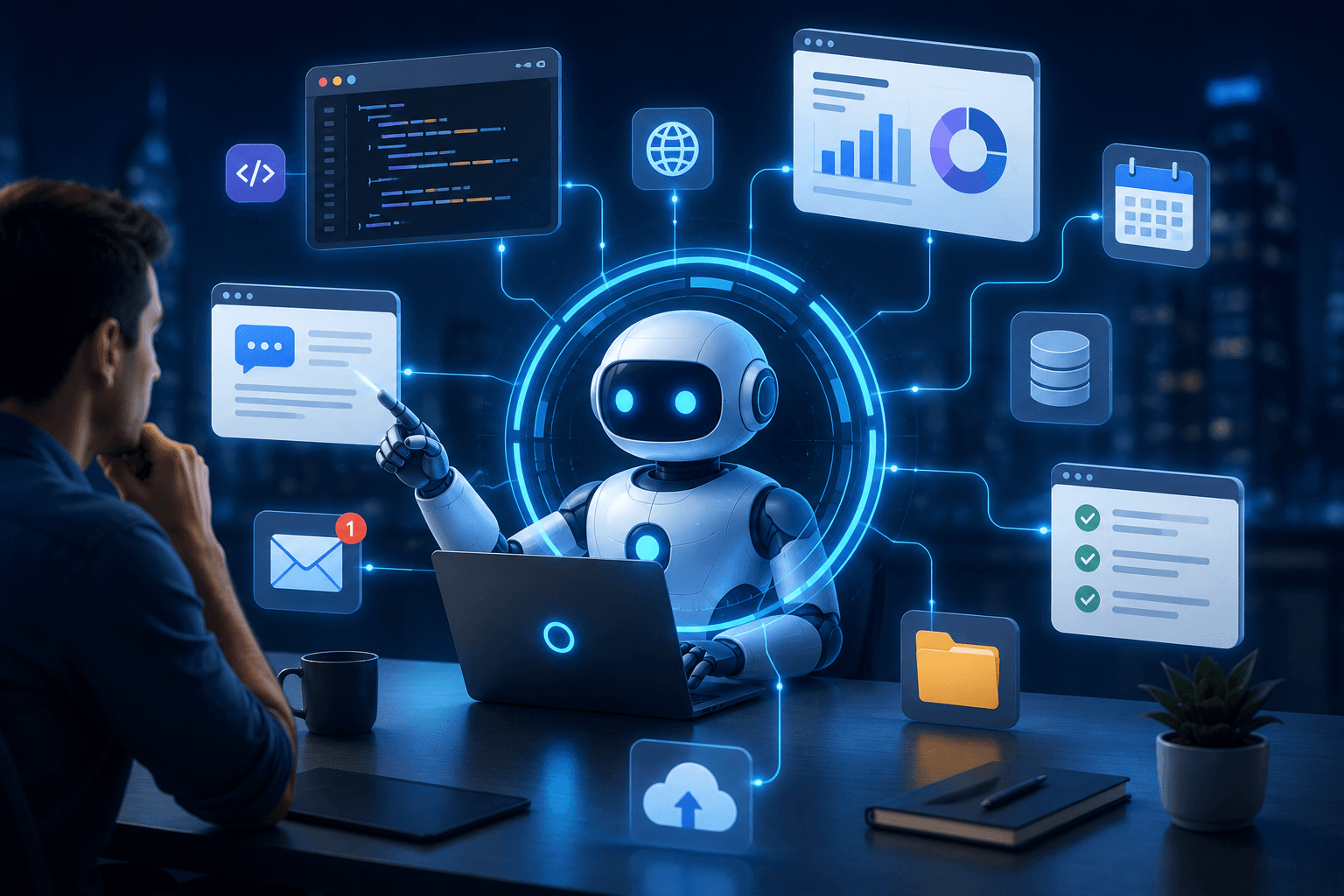
The age of autonomous agents seems imminent as autonomous agents go far beyond being conversational tools like chatbots and start performing functions which were previously dependent upon user input.
As a result of the emerging trend, businesses have started experimenting with agent-based solutions in their research, customer service operations, software development, and work productivity. The trend is highly relevant for job seekers as well as entry-level workers who will soon find themselves facing increased opportunities as AI agents, LLMs, and AI automation become mainstream.

What Are Autonomous Agents and How Do They Work?
An autonomous agent is an artificial intelligence tool that can do certain tasks on behalf of its user. In contrast to a regular chatbot that responds only to user commands, autonomous agents have the ability to break objectives into smaller tasks and carry them out autonomously.

The technology uses four types of tools – Large Language Models, memory systems, external applications, and reasoning modules. All these elements help an AI agent collect data, make decisions, and accomplish certain tasks. While a chatbot may give some travel advice, an autonomous agent could look into different options, analyze their cost, prepare an itinerary, and make necessary reservations with permission. Many people refer to such transition as a shift from “answer engines” to “action engines,” the difference being execution.
Why Autonomous Agents Are Replacing Traditional Software Interfaces
For many years, computer programs used graphical user interface systems where users clicked buttons, opened menus, and worked on screens to accomplish tasks. But there is another perspective with agentic agents.
Users define the target and let agents carry out necessary operations. For example, employees may instruct an AI agent to create a market report. It will collect data, structure information, and make a document all at once.

Thus, an agentic system looks like digital labor instead of regular software. User concentrates on achieving his goals, while a system works out solutions. Organizations explore this way of working with agents in customer support, productivity tools, code generation services, and other enterprise software.
Multi-agents systems usually comprise several specialized agents that perform particular operations. While one performs research, another makes sense of gathered information. A third agent completes the job and provides users with the needed result.
The Technology Behind AI Agents
Several technologies support the rise of autonomous agents. Large Language Models function as the reasoning component. The Retrieval-Augmented Generation framework, also known as RAG, enables agents to use information from external sources in addition to their training data.
Memory modules assist the agents in retaining context in extended conversations. Integrating tools into an agent involves connecting it with various external systems such as databases, calendars, emails, search engines, and enterprise applications. In this way, an agent can execute tasks instead of simply generating text.
Another area being explored is the development of orchestration frameworks for coordinating AI agent operations. Some examples of platforms in this space include LangGraph, AutoGen, and CrewAI.
Despite recent progress, technical limitations persist. An AI agent might sometimes generate erroneous responses, misinterpret goals, or face security concerns when using external services. For this reason, human intervention is common practice for making critical decisions.
How AI Agents Are Creating New Career Opportunities
As more and more autonomous agents emerge, there will always be a need for individuals familiar with AI-based software. The need for professionals skilled in areas such as prompt engineering, workflows automation, data management, and AI systems creation has been growing lately.
For fresh graduates and job seekers, a number of choices can be made within this field. Knowing how to work with Python, APIs, AI automation, or even working with open-source agents would come in handy.
According to industry experts, more and more software will include autonomous agents in the future. Even as technology develops further, it is clear where it will go. Traditional software that depends only on buttons and menus might be obsolete in the future. The role of interfaces might be played by AI agents.