
Why Your Protocol Passed Every Audit but Still Got Exploited
Learn why protocol security requires more than smart contract audits and discover how leading DeFi projects defend against real-world exploits.
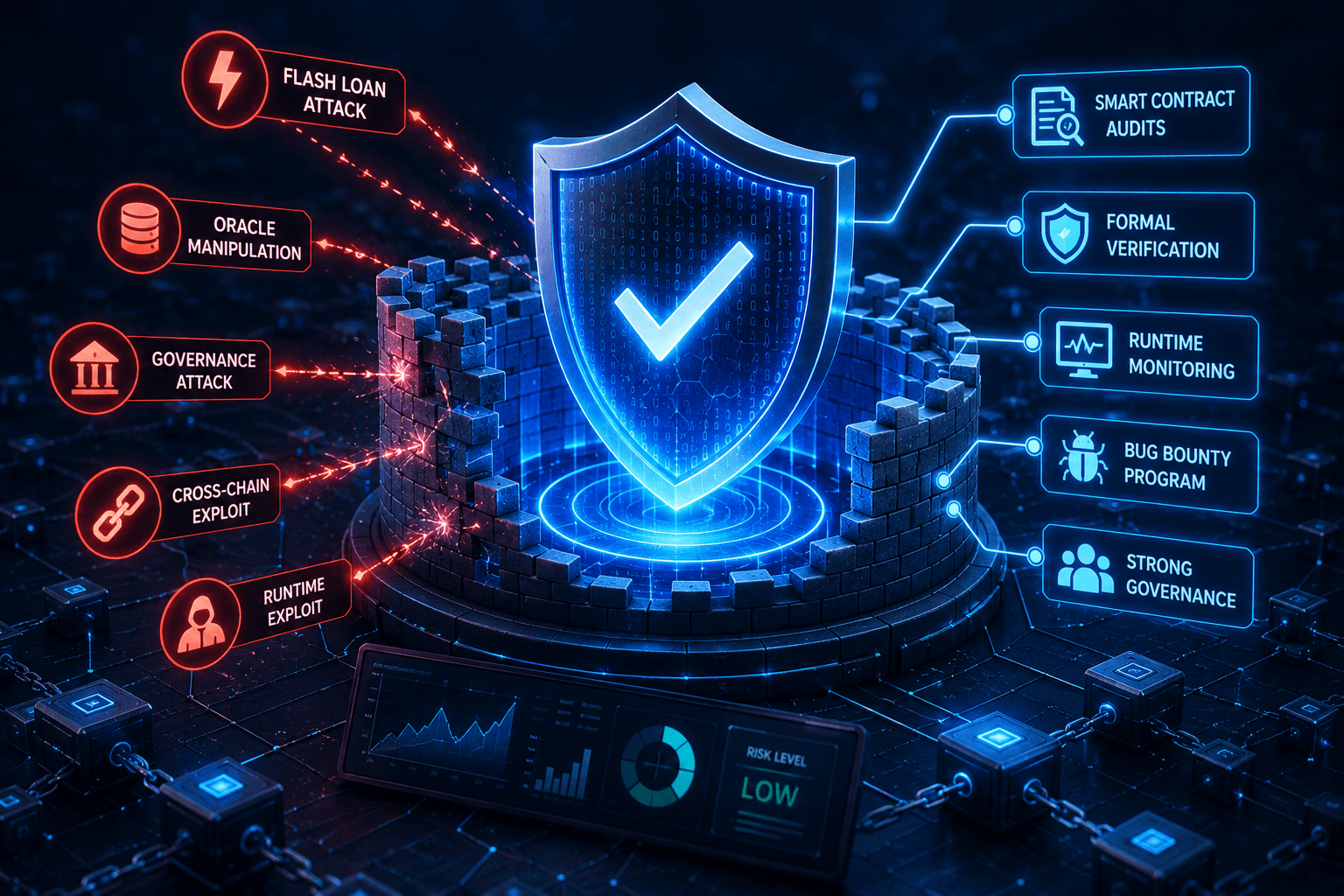
While a smart contract audit may be able to detect coding errors prior to the actual deployment, it is not enough to ensure that the blockchain protocol stays safe even after it is launched. Protocol security involves more than just checking the code. There is also governance, economics, oracles, inter-blockchain communications, and monitoring among others. A number of projects that did several audits ended up losing money because attackers exploited weaknesses outside of the audit’s scope.
Why Protocol Security Goes Beyond Smart Contract Audits
Smart contract audits assess the security compliance of the source code according to best security practices. They analyze the logic of the contract, point out the vulnerabilities and give advice on how to fix the problem. Even though such a method lowers the number of bugs in the software, it still is a part of protocol security.

The blockchain protocol runs in a changing environment where price oracles update their information, different economic governance proposals come to life and cross-chain bridges swap coins from one blockchain to another. A protocol that acts securely during tests can act unpredictably during real-life market conditions.
Common Attack Paths After an Audit
A few high-profile attacks have happened even after security audits were performed on protocols. Flash loan attack makes use of an attacker borrowing a big chunk of capital in a single transaction. They can manipulate the prices or the protocol itself before settling the loan back. In the event that the protocol depends on the price change temporarily, losses will be made in seconds.

Another attack that is a threat to protocol security is the oracle manipulation. There are many decentralized apps that depend on external feeds that give prices of assets. When there are manipulations from such sources, wrong liquidations, borrowing of extra assets, or draining of protocol reserves happens.
Continuous Monitoring Strengthens Protocol Security
Security needs to persist even post-deployment. Runtime monitoring monitors blockchain operations in real time, alerting developers of any strange patterns that arise. It is akin to the security cameras in a building. Putting locks in place is helpful, but an additional level of security exists after people enter the building.
Most protocol development teams utilize a combination of runtime monitoring along with on-chain analytics, automated alerts, and anomaly detection. Such technology studies transaction behavior, wallet behavior, liquidity movement, and governance activities. Should any strange patterns arise, the team can conduct an investigation before the attackers do further harm. Bug bounty schemes help in reporting bugs.
Building a Layered Protocol Security Strategy
Secure protocol security require a range of defense mechanisms rather than just an audit. Development teams usually implement separate code review, formal verification, access control validation, and governance simulation before rolling out new functionality. With formal verification, mathematical proofs are used to prove that the behavior of smart contracts meets certain criteria.

Once deployed, most protocols continue to test security using updates, monitoring, incident response, and a community-based bug bounty program. Each defense mechanism takes care of different risk vectors that may not be handled by other controls. Audits still play an important role, but they are most effective when combined into an overall protocol security framework.
Final Thoughts
The process of protocol security is continuous and not one-time achievement. Audits of smart contracts can assist in recognizing the issues of the code before deploying it into production; however, it will be impossible to foresee all risks that can appear afterward as a result of economic, governance, or infrastructural issues. With the evolution of blockchain networks, new attack vectors keep appearing in order to prove the resistance of existing production protocols.
The combination of audits, runtime monitoring, formal verification, bug bounties, and proper governance can provide several layers of protection from potential threats to the protocol. This will contribute to minimizing the attack vector and increase the capability of spotting any suspicious activity. Protocol security becomes crucial for those projects that have digital assets managed by them at scale.