
Agent Memory Poisoning: The Next Big Threat in Agentic AI
Learn how Agent Memory Poisoning threatens Agentic AI systems, how attacks work, and the best security practices to prevent them.
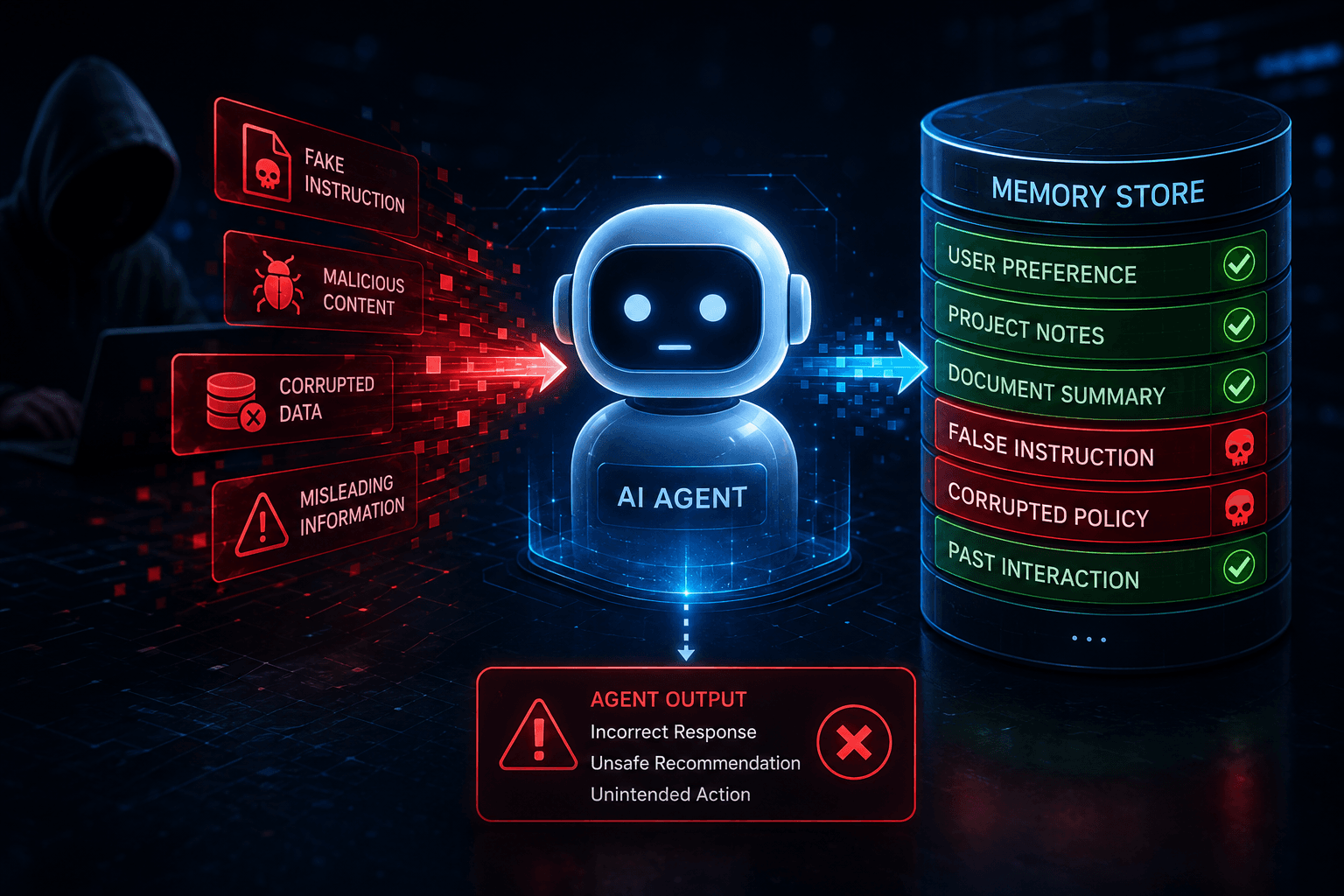
AI agents can plan tasks, use tools, and retain information across sessions. That capability has expanded their role in software development, customer support, research, and business operations. Conversely, researchers in security studies and artificial intelligence experts have been increasingly concerned about the threat that has emerged called Agent Memory Poisoning.
This problem relates to the ability of agents’ memory to be infected with harmful information that would affect their decision-making process. Different from conventional prompt injection attacks, Agent Memory Poisoning affects an agent throughout several sessions. As companies introduce autonomous AI into the operational environment, developers have been increasingly focused on how an agent manages its memory.
What Is Agent Memory Poisoning?
Agent memory poisoning happens in scenarios where an adversary uses data poisoning tactics by manipulating information stored in memory modules of an AI agent. The motive behind this kind of attack is to influence the outputs or actions taken by the agent in future.
Modern-day agents have memory layers that they use to retain data across multiple sessions. Memory models of the agents include vector databases, a mechanism used to retrieve information from the memory and long-term storage of information in memory.

The idea behind memory poisoning is to trick the agent into storing malicious information. This could be done by creating false instructions, corrupting database records or misleading the agent. When retrieving memory at a later date, the system will consider the corrupted or manipulated information as authentic.
The example of an individual taking incorrect notes on a project but assuming the notes are correct a few weeks later illustrates the same idea.
How Memory Poisoning Differs From Prompt Injection
Prompt injection threats usually take place within one instance. The attacker injects codes aimed at altering the behavior of the AI application. Afterward, the effects of the threat will be nullified once the interaction ends.
Agent Memory Poisoning is another type of threat that poses various problems. Since malicious information is stored within the memory of the agent, there is a possibility of triggering this kind of threat for future interactions despite the absence of the original threat agent.

A case in point would be an AI coding assistant who saves wrong programming guidelines. This may result in a situation where several days later, this agent uses the wrong guidelines as references and suggests them to the programmer, without knowing the origin of this information.
Technical Risks for Autonomous AI Systems
Many Agentic AI Security frameworks focus on protecting models and application interfaces. However, AI Agent Memory introduces an additional attack surface. Every stored memory entry becomes a potential target.
Several attack scenarios have emerged within research discussions. One involves injecting false system policies into memory. Another targets retrieval systems by creating content designed to rank highly during memory searches. Some forms of attack involve trying to influence the decision process of an agent through the insertion of false information over time.
Increased use of multi-agent frameworks might lead to greater vulnerability in this regard since the exchange of information and cooperation between agents is common in such environments. False information in one agent’s memory might then propagate into others as well as other AI systems.
There are also issues with assigning blame in such cases since distinguishing between mistakes made due to faulty programming versus misinformation in either data or memory takes significant investigation.
Security Measures Against Agent Memory Poisoning
Developers are considering several solutions to address the problem of Agent Memory Poisoning. First, developers suggest verifying information before storing it in long-term storage. Another solution concerns rating memories depending on the degree of their authenticity and verification.

Several organizations are creating memory auditing services. These systems monitor when memories appear in the database, how many times agents use this information, and whether there are any changes in user behavior regarding memories modification.
Additionally, some AI Agent Security models divide memories into trustworthy and unverifiable types. In this case, agents receive access to both databases, but apply different weights to their influence on decision making.
With the development of Agentic AI Security practices, memory security is increasingly gaining its importance. Developers understand how to secure networks, applications, and databases. The next challenge involves securing the information that autonomous agents remember and rely upon every day.
Agent Memory Poisoning remains an emerging area of research. Questions remain about the most effective defenses and industry standards. What is clear is that memory systems are becoming a core component of modern AI agents, and securing them is moving closer to the center of AI security discussions.