
LLM Observability Is Broken in Production Systems
LLM observability is broken in most AI systems. Learn how to debug production LLM pipelines with proper tracing, evaluation, and monitoring.
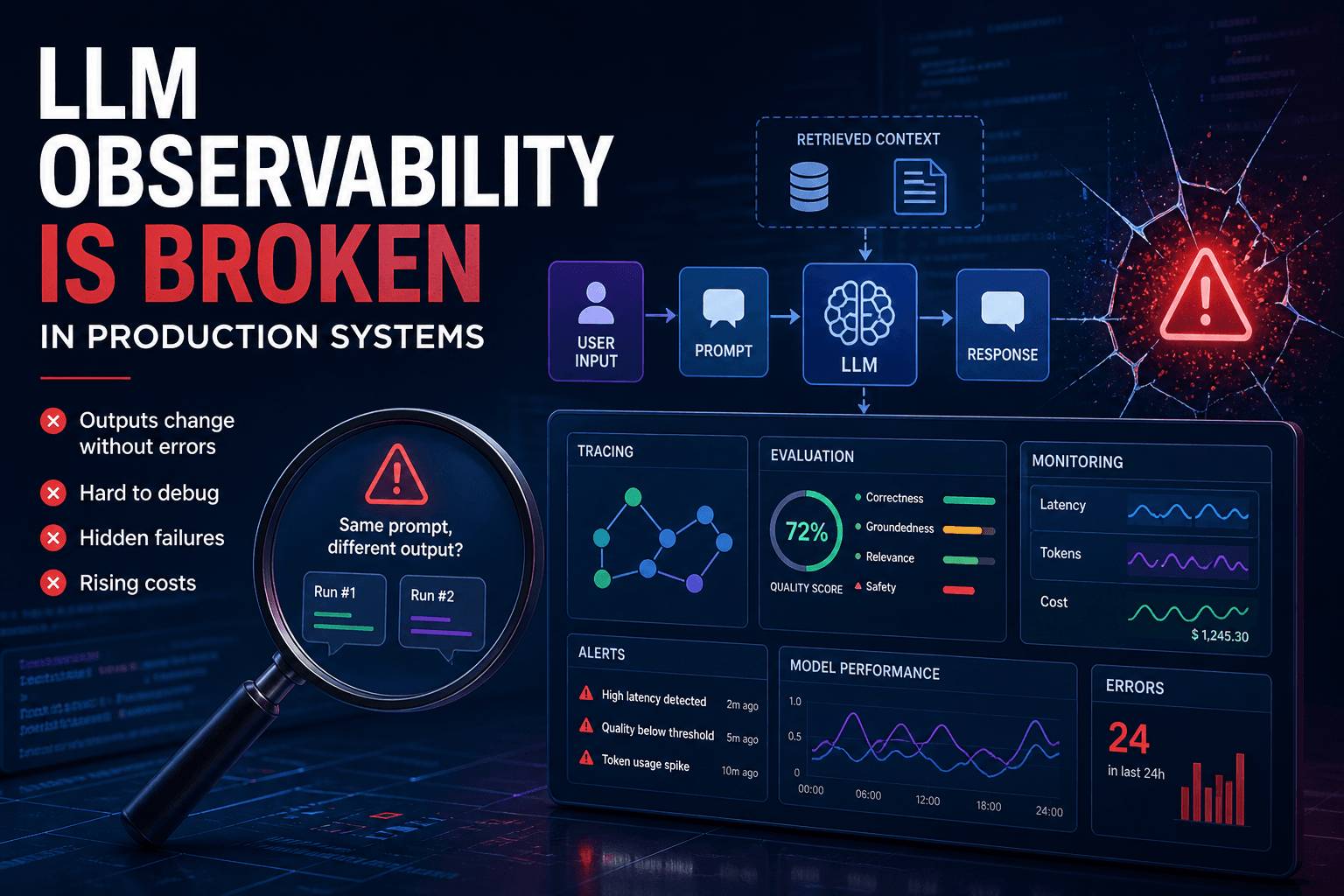
Production teams are reporting gaps in LLM observability as large language models move into core systems. Sources such as LangSmith and Weights & Biases show that standard monitoring tools track infrastructure but miss how models behave. This gap has made LLM debugging harder, especially when outputs change without visible system errors. Engineers on X have also shared cases where identical prompts produce different responses, raising questions about how production systems are monitored and evaluated.
Engineers Report Gaps in LLM Observability
Concerns about LLM observability in production systems are gaining attention across developer communities. Monitoring data from services like Langsmith and Weights & Biases indicate the ineffectiveness of current monitoring systems for tracking model behavior. The following evidence proves that there have been repeated problems of varying outputs with no apparent malfunction in the system.
Early warnings indicate a disparity between systems-level metrics and model-level metrics. Engineers complain that logs indicate the path of requests but do not explain the differences in the output. The problem mentioned above has impacted debugging practices in production LLMs.
Such topics are also covered by engineers in the posts on X. Specifically, engineers provided an example where they had got different outputs despite sending the same prompt twice. Such posts reveal cases where monitoring indicates stable infrastructures while providing inconsistent output.
Limits of Traditional Monitoring in LLM Systems
Traditional monitoring tools are centered around system health status. Tools such as Prometheus and Grafana monitor CPU utilization, memory usage, and request latencies. These indicators can reveal problems in hardware and network connections but are incapable of providing any information on how a model processes input and produces output.

LLM provides stochastic output. Identical inputs can result in varied model output. This behavior creates challenges for LLM monitoring. While logs may be recording all normal processes, the output may not conform to task specifications. This makes it impossible for developers to depend only on system statistics during problem-solving.
A further constraint pertains to prompt processing. In real-time systems, prompts comprise system commands, user inputs, and context. Without structured prompt tracing, teams cannot reconstruct how each component influences the final output. This makes LLM debugging dependent on manual inspection.
New Tools Focus on Prompt Tracing and Evaluation
To address these issues, teams are adopting tools designed for AI observability. LangSmith platform is one such platform that enables end-to-end tracing of prompts and responses. All processes, including transformations and retrieval of data, that go on in the lifecycle of request are captured.
Tracing of such requests helps in finding out where the response differs from expected. Tracing also facilitates comparison between different variations of prompts and models. Consequently, teams find it easier to figure out what causes inconsistency issues.

Evaluation frameworks are also important in ensuring consistency in responses generated. Weights & Biases allows for scoring of outputs to determine whether the response is correct or not.
Token-level monitoring has also emerged as part of LLM observability. The team monitors the number of tokens used, length of responses generated, and the cost per call. This information is used to optimize the design of the prompt and choice of models used.
Shift Toward Structured LLM Observability Architectures
Organizations are redesigning their infrastructure to support full LLM observability. An example architecture consists of traces, evaluations, and dashboards. The integration of these elements serves the purpose of achieving visibility with regards to the performance of the system and models.

Engineers have also begun incorporating feedback into production pipelines. Feedback from users and automatic evaluation results are fed back into continuous improvements. The process leads to the improvement of prompt quality and response uniformity.
According to conversations on X, more engineers are using this methodology. They state that debugging is more efficient when evaluation and trace methods are combined.
Final Thoughts
As adoption of large language models expands, teams continue to adjust their infrastructure to address gaps in LLM observability. These changes reflect a shift from traditional monitoring to systems that track both performance and output behavior.