
Why Ethereum Gas Fees Exist and How Layer 2 Helps
Learn why Ethereum gas fees exist, what causes them to rise, and how Layer 2 solutions reduce costs while improving speed.
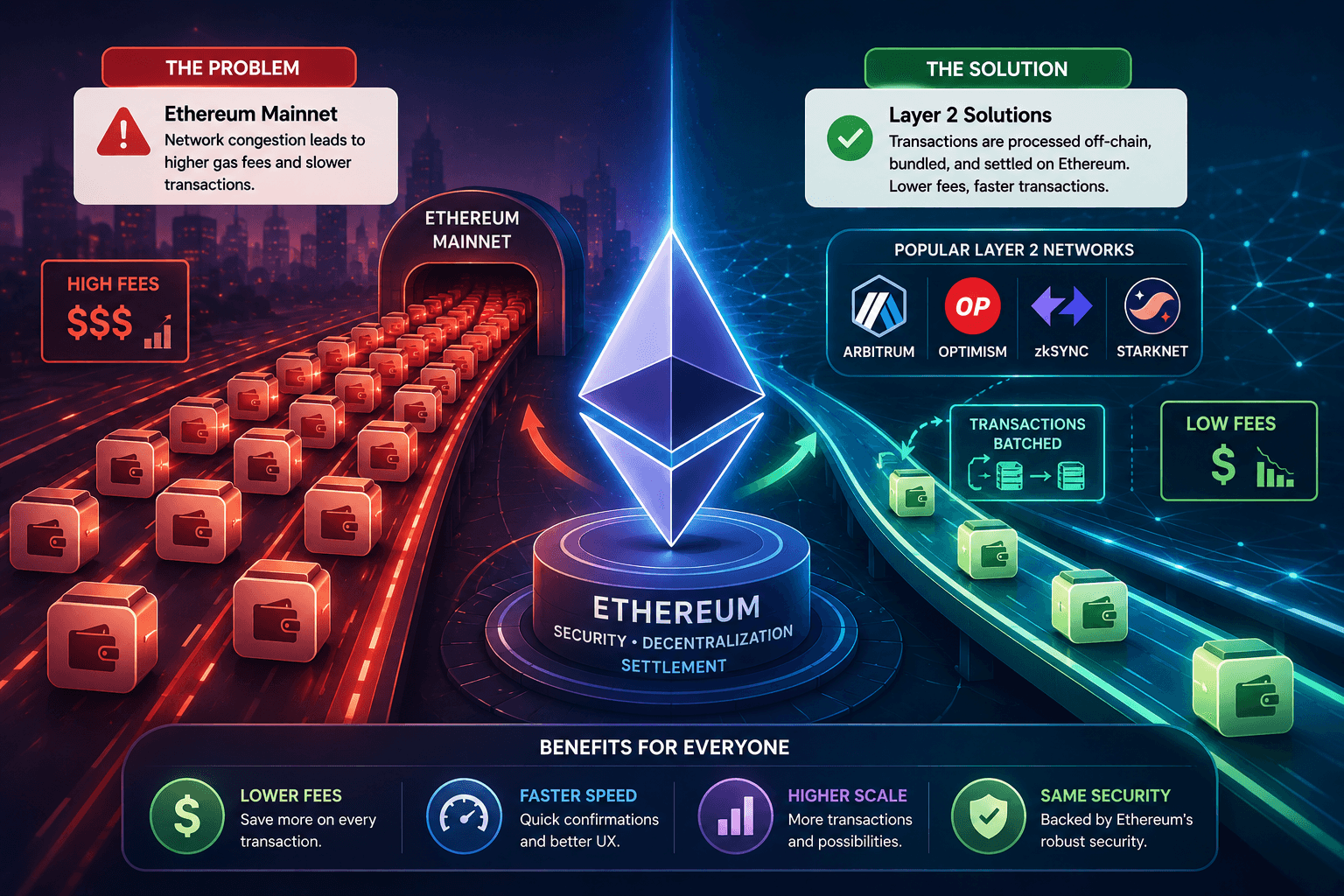
Ethereum gas fees have always been at the forefront of discussions about the blockchain ecosystem. Although there are thousands of decentralized applications available on Ethereum, many users incur higher fees during times when the blockchain network is active. That is why people are looking for methods through which the cost could be reduced without sacrificing security.
Layer 2 solutions are becoming increasingly popular among people who are trying to resolve issues relating to Ethereum gas fees. This technique involves processing the transactions off the blockchain while using the Ethereum security mechanism.
What Causes Ethereum Gas Fees to Rise
Ethereum gas fees can be understood as payment for carrying out transactions and implementing smart contracts within the network. Any action on Ethereum consumes computing power. The users pay such fees to reward the validators processing the transactions.

The network is designed to have constrained block space. As demand increases, users bid for available space by providing higher fees. Such competition tends to drive Ethereum gas fees up. The occurrence of popular events like token sales, DeFi transactions, and NFT trading typically causes network congestion.
This fee mechanism operates in much the same way that traffic operates on a congested highway. An increase in cars trying to travel down the road results in an increased level of congestion. With regard to the Ethereum network, more transactions equate to higher fees.
How Layer 2 Solutions Reduce Ethereum Gas Fees
Layer 2 scaling solutions validate transactions off the main blockchain of Ethereum. These transactions are bundled together into one, which is then sent back to Ethereum. The benefit is that the volume of information being put directly on the main chain is reduced.
Due to the spread of costs among many users, the fee for one operation will be significantly lower than if it was conducted on the Ethereum blockchain. Transactions, exchanges of tokens, and operations with smart contracts become more affordable.

For developers, transaction speeds will increase. There will not be any problems with block capacity in applications due to the higher speed of transactions and less use of block space on the main blockchain of Ethereum.
Understanding Rollups and Layer 2 Architecture
Rollups provide the basis for many Layer 2 solutions. These gather up transactions, batch process them, and then return the batched information to the Ethereum network. Two types of rollups are Optimistic Rollups and Zero-Knowledge Rollups or ZK-Rollups.

The optimistic rollup assumes that all transactions are correct until they are proven to be otherwise. This helps keep computational costs low. The ZK-Rollups verify the transactions before they post any data on the Ethereum network.
Both strategies have one goal: reducing Ethereum gas fees and improving scalability. Though the methods differ in execution, the idea is the same in both cases: achieving processing efficiency without placing additional pressure on the Ethereum main chain.
What Lower Ethereum Gas Fees Mean for Developers
High Ethereum gas fees could lead to issues concerning the usability of an application. People might not undertake any transaction due to its price being higher than the actual value they wish to transfer.
Layer 2 networks assist in getting rid of some of these limitations. Reduced costs will allow microtransactions, blockchain games, and DeFi services to become a reality. Application development can be done at a mass scale without having to pay large transaction fees.
The scaling approach for the future of Ethereum will still revolve around Layer 2 solutions. With increasing adoption rates, these solutions should take up the bulk of transactions that happen through the blockchain network, with Ethereum serving as the foundation layer.