
How Layer 1 Blockchains Scale: Ethereum, Solana, Sui & Aptos
Learn how Layer 1 Blockchains achieve scalability by comparing Ethereum, Solana, Sui, and Aptos architectures, performance, and design.
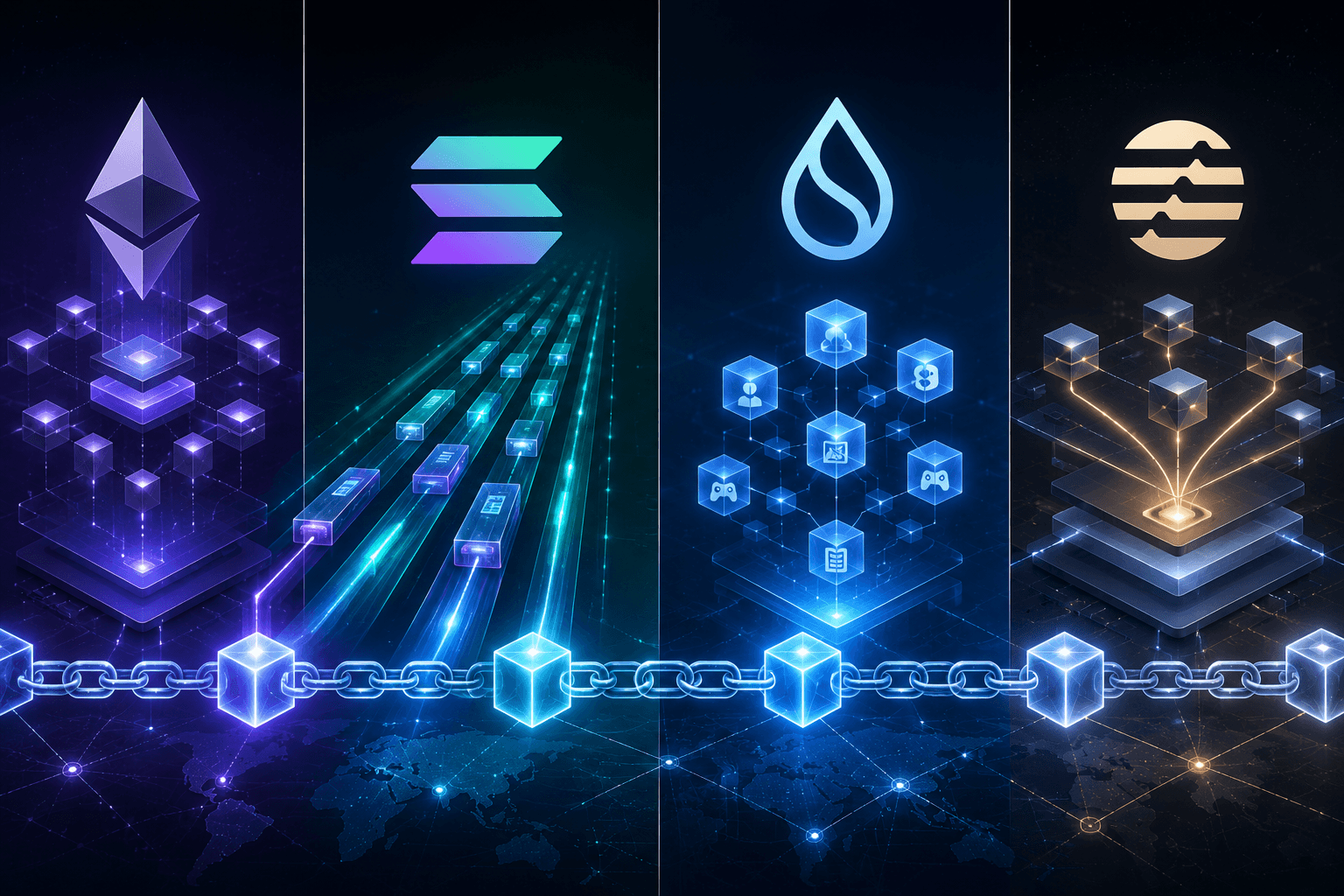
Layer 1 Blockchains form the very core of cryptocurrency technology. They execute operations, guarantee network safety, and support dApps, all independent of other blockchain technologies. In the midst of growing blockchain adoption, developers and architects find themselves consistently exploring how these different Layer 1 Blockchains deal with the issue of scalability amidst security and decentralization.
The four notable players in this field, Ethereum, Solana, Sui, and Aptos, each employ distinct approaches in solving such problems. In spite of the common goal of improving transaction throughput, they differ greatly in terms of operation and functionality.
Why Layer 1 Blockchains Face Scalability Challenges
Every blockchain has to be able to handle transactions, validate information, and reach consensus on its decentralized platform. With increasing amounts of activity, this becomes increasingly difficult. The challenge faced by any network lies in balancing these three aspects, a problem known as the blockchain trilemma.

A comparison to make here is the highway system where too many cars and not enough roads will result in traffic. In blockchains, this happens similarly whenever the number of transactions goes beyond the network’s ability to accommodate them. This is what Layer 1 blockchains try to address. This has implications for costs, with congested networks often seeing high fees due to inefficient processing of transactions.
Ethereum’s Modular Path to Layer 1 Scalability
Ethereum is the biggest smart contract network based on developers’ involvement and the size of the network. While most other Layer-1 networks focus on the scalability of the network and maximizing its transaction capacity, Ethereum has opted for a modular approach.
As a result of the Merge, the Ethereum chain shifted to Proof of Stake (PoS), significantly decreasing its carbon footprint. The future developments for Ethereum include improving data availability and developing Layer 2s to enable high transaction volume processing and settlement security on Ethereum Mainnet.
In order to ensure decentralization and sustainability, this approach is the most optimal one for Ethereum. Nevertheless, Ethereum Base Layer can process less transactions per second compared to some of the new generation Layer 1 Blockchains. Despite that, Ethereum’s architecture is suitable for building applications that need security and strong ecosystem support.
Solana’s High-Performance Blockchain Architecture
However, Solana takes a different approach. The network prioritizes optimizing performance through the Layer 1 approach. The network uses a combination of Proof of History together with Proof of Stake to ensure transactions have timestamps prior to validation by the validators.
This results in lower coordination costs between network participants. Therefore, Solana is capable of processing numerous transactions per second during optimal performance. In addition, the network ensures low transaction costs, thus appealing to consumer-based apps.
To achieve its high scalability, Solana uses a parallel processing architecture referred to as Sealevel. The network processes numerous compatible transactions concurrently instead of doing it one by one like single core processors that do things in series.
This comes with the disadvantage of requiring powerful computers to act as validators. The hardware required to support network operations is often more powerful than those used in other competing Layer 1 Blockchains.

How Sui and Aptos Use Parallel Execution
Sui and Aptos are built on the technologies created by Meta during its Diem blockchain project. Both networks rely on the Move programming language and parallel execution of transactions.
Blockchain-based systems traditionally process transactions sequentially. Sui and Aptos can identify which transactions have no interaction with the same assets or state objects and, hence, can be executed in parallel.

Sui has an object-based data model where digital assets are stored as individual objects. Thus, many transactions can operate independently without requiring consensus among all nodes in the network, which leads to higher throughput and reduced latency.
Aptos has a parallel execution engine called Block-STM that processes transactions in parallel and solves eventual conflicts in case of overlapping transactions.
These platforms were designed to support applications that require fast execution and good user experience. Popular use cases include gaming platforms, social apps, and consumer-grade services.
Comparing Layer 1 Blockchain Design Trade-Offs
Each Layer 1 Blockchain possesses a different architectural philosophy in relation to scalability. For Ethereum, scalability along with modularity comes into play, besides a well-developed ecosystem. On the contrary, the philosophy of Solana lies in optimizing the Layer 1 blockchain for improved performance. Parallelization is another key aspect of Sui and Aptos’ architectures.
Their designs try to eliminate factors that restrict the ability to execute transactions within typical blockchains. No single blockchain system can address every issue. It is up to software developers to determine which factors such as the ecosystem, the assumption regarding the security of the platform, validators, transaction speed, and application needs come into play when making the decision.
In essence, the evaluation process by software engineers is not limited to the technology used by the Layer 1 Blockchain. It also involves fundamental concepts related to distributed computing systems. Some computing systems emphasize agility, whereas others focus on performance or scalability.