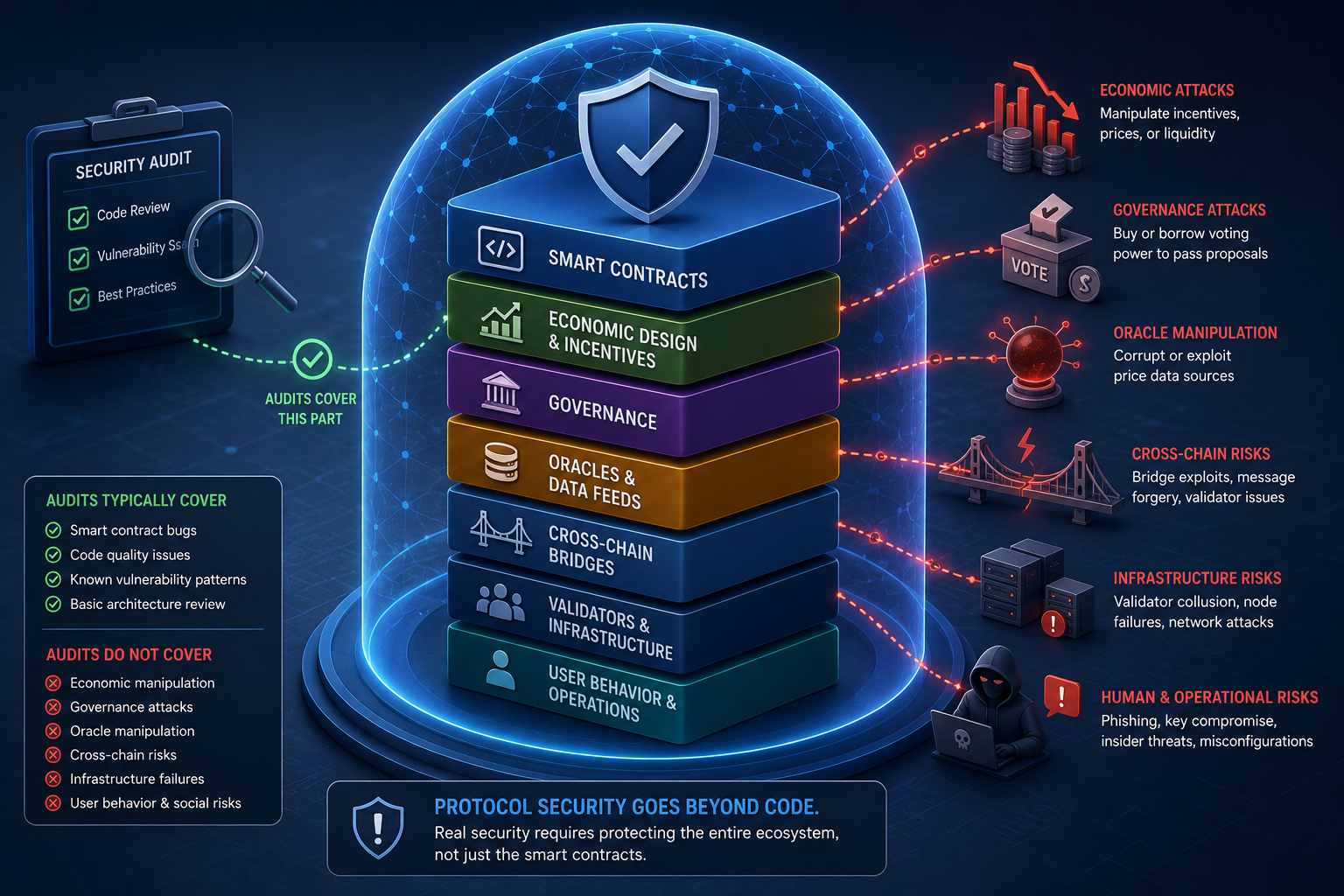

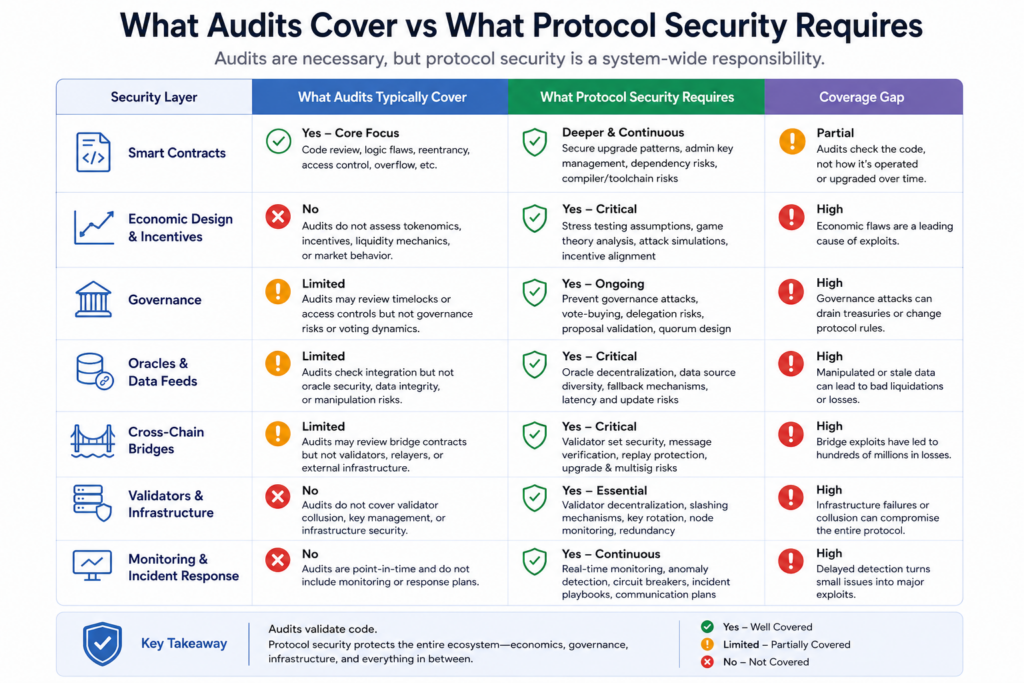
Even when a protocol passes all security audits, major exploits can still happen. This issue is getting tons of attention in blockchain security. Attackers are now focusing more on areas beyond just smart contract bugs. While security audits remain a core part of protocol security, Several high-profile incidents prove that even audited code isn’t foolproof. Today’s attacks typically exploit economic incentives, governance systems, outside dependencies, and cross-chain structures, not just the code.
As DeFi keeps growing, protocol teams need to protect way more than just smart contracts; they have to safeguard the whole supporting system too. Figuring out what goes beyond audits and what constitutes the protocol security design is now a major issue for those constructing large-scale blockchain infrastructures.
Why Security Audits Have Limits
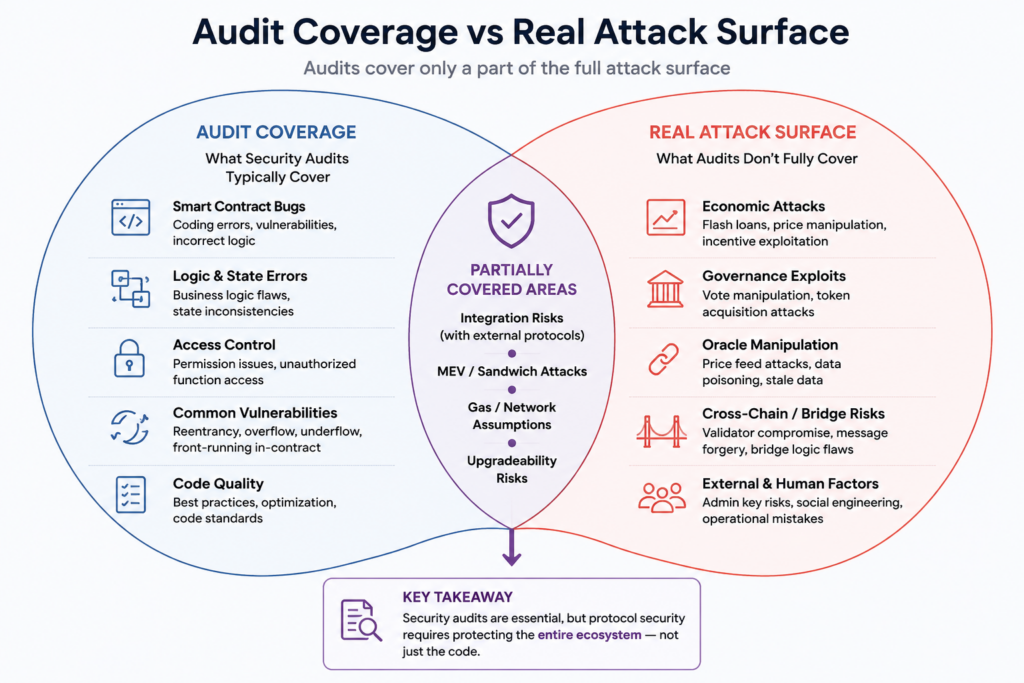
Security audits help find coding errors, logic flaws, and vulnerabilities in smart contracts. Audit firms look at code and check how contracts work in various situations. This cuts down on risks, but doesn’t get rid of all potential attacks.
A lot of audits just check if the code does what it’s supposed to. They don’t see if the economic model of a protocol can handle real-world manipulation. So, an attacker might exploit incentives without breaking any actual rules.
In decentralized finance, this difference is super noticeable. Several protocols got hit even after thorough audits. The attackers often used functions exactly as intended, but in really unexpected ways, to pull off their hacks. As a result, protocol security now requires a wider assessment that includes incentives, governance structures, liquidity design, and user behavior.
Economic Attacks Often Bypass Traditional Reviews
Economic attacks have become one of the most frequent threats to protocol security. Instead of focusing on a system’s tech setup, these attacks target its financial structure.
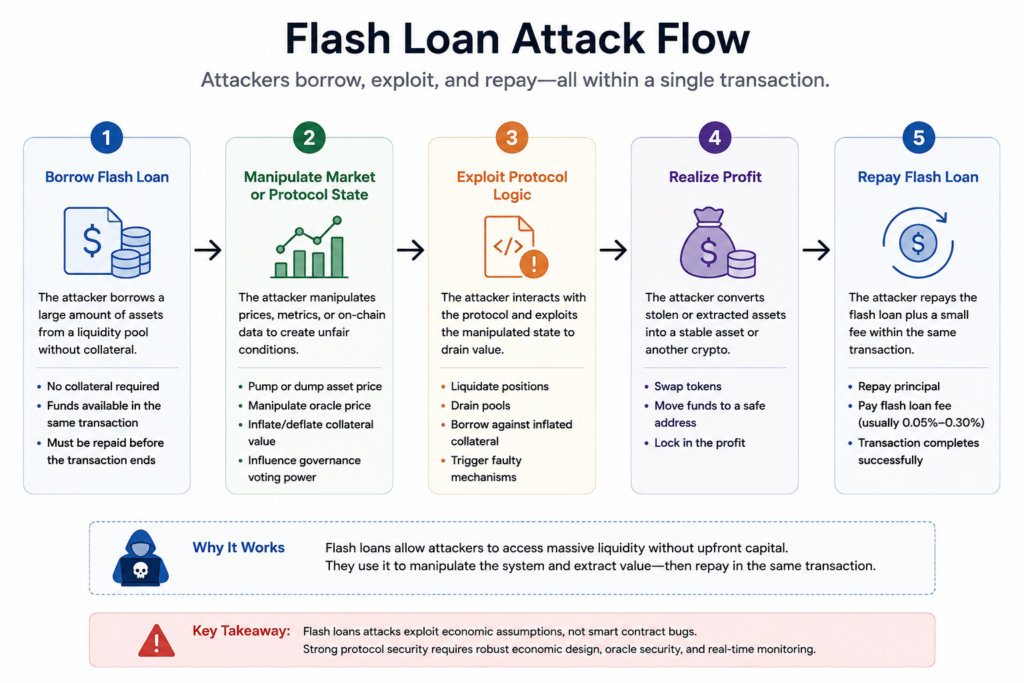
Flash loan attacks are a perfect illustration. With these loans, users can quickly borrow big amounts for a single blockchain transaction. So, attackers can use this brief burst of liquidity to mess with prices, sway governance votes, or warp market conditions; then they repay the loan and walk away unscathed.
Another major issue is oracle manipulation. Lots of decentralized systems rely on external price feeds to perform their tasks. If attackers mess with these data sources, they can rig things to make money. From a security angle, this shows weaknesses in the business rules, not errors in the software. The code might work fine, yet such tricks can still result in losses.
Governance and Infrastructure Risks Continue to Grow
Governance attacks are big problems for blockchain security teams nowadays. In decentralized systems, token owners vote on upgrades and changes. Trouble begins, though, when too much voting power ends up in one place. Attackers can buy enough tokens to push their own agendas, and sometimes they even use borrowed tokens just to get that control.
These issues aren’t just limited to one blockchain. Many use bridges to transfer assets across different networks. And because bridges handle so much locked-up value, they’re a prime target.
It gets tricky too, because protecting against these bridge hacks isn’t as simple as checking for smart contract bugs. Validator compromises or message verification fails can happen. So, protocol security teams need to check every piece of the puzzle, not just what’s on-chain.
Building Protocol Security Beyond Audits
Effective protocol security needs technical checks, economic analysis, and operational safeguards. While audits are great defenses, they’re just one piece of the puzzle.
Nowadays, many teams run simulations where they imagine how bad actors could take advantage of loopholes under crazy market conditions. On top of that, some implement bug bounty programs and use tools to watch for fraud in real-time.
Take modern buildings as an example: passing a structure check shows the building follows engineering rules, but that doesn’t promise total safety from, say, earthquakes or trespassers. Protocols in decentralized systems face the same deal.
With this complexity, to keep protocols safe long-term, you have to secure more than just the tech, you’ve got to think about how the incentives and rules work together across the whole system. So, while audits can show good coding, true protection involves way more than that.