
Web3 Development: Build DApps That Users Actually Need
Learn web3 development by building real-world DApps that solve problems, attract users, and stand out beyond clone projects.
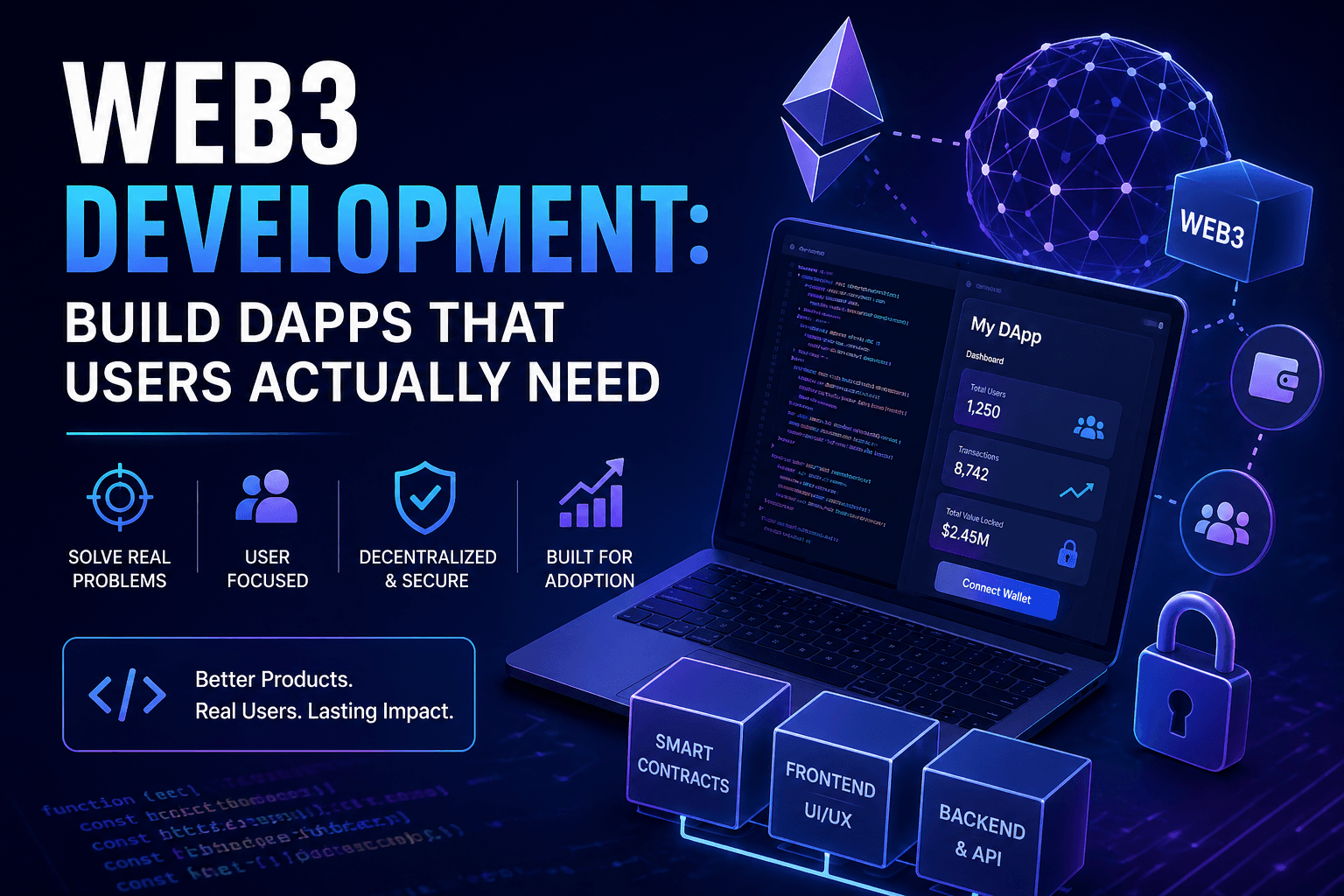
The Web3 development ecosystem keeps attracting young developers to build their projects, but most of them lack traction. Information extracted from developer forums and publicly available repositories reveals a commonality of multiple deployments with little to no actual use. Conversations within the industry on platforms like X (Twitter) increasingly highlight that adoption is becoming a serious issue amid an increasing number of developers.
Why Most Web3 Development Projects Fail Today
Web3 development projects usually copy already existing platforms, such as decentralized exchanges, NFT generators, and token management tools. Usually, these projects lack a unique selling proposition, making them hard to gain traction outside test environments.

Many web3 developers on X have observed that most repositories launched recently exhibit great technical quality, while they lack end-user considerations. An engineer once commented on the X platform that “it’s easy to ship code but rare to ship something people can actually use.” This statement has resonated with many web3 developers.
Additionally, user research is usually ignored by web3 developers. Developers tend to start projects based on tools or frameworks, leading to the creation of projects that work well without solving real issues. Eventually, the projects become irrelevant due to the emergence of solutions that cater to users’ needs.
Web3 Development and Problem-First Design Approach
Those who have excelled in web3 development start from defining a use case. As opposed to using various attributes of blockchain technology to guide their development process, developers try to identify deficiencies within current systems.

These deficiencies can be related to issues of trust, transparency, or ownership. Decentralized escrow systems are useful for resolving issues within freelance payment systems. On-chain reputation systems are useful for confirming credibility among users.
Conversations within GitHub and developer forums demonstrate how problem-based solutions lead to efficient architecture designs. Developers do not include any complex logic within smart contracts. Developers minimize the cost of transactions on-chain through reducing on-chain activities.
Designing Scalable Web3 Development Architecture
Web3 development entails working with different layers of a stack. The general stack consists of smart contracts, indexing, backend API, and frontend application.
Smart contracts perform operations and state management on the blockchain. Most developers use solidity when developing Ethereum-based smart contracts. On the other hand, indexing is done by indexing engines such as The Graph. Indexing helps in faster querying of blockchain data. Applications without indexing query blockchain directly from nodes, which is slower.

A frontend application connects the user to blockchain via a wallet such as MetaMask. These applications should handle transaction management and network errors. Backend applications might even keep caches for faster querying.
X engineers have mentioned the need for modularity in web3 development. In one thread, an engineer noted that modularity helps prevent points of failure in web3 applications.
User Acquisition in Web3 Development Projects
Developing an app does not ensure its usage. There is a need for developers to interact with communities where prospective users are present. Discord and X are among some of the most important distribution channels.
There is usually the need for regular updates to create visibility. Developers who keep the community updated with what they are working on often receive more attention. This helps to foster trust among members of the community.
Other developers have resorted to releasing the first version of their apps for testing purposes. Users are able to give feedback based on how the app works and the features that should be included.
From discussions that have been shared on social platforms, it is clear that distribution strategies today hold the same importance as development.
Final Thoughts
The development of Web3 is now moving away from creating multiple projects and towards solving real-life issues. Projects that tackle real-life problems are much more likely to be adopted by users.
That being said, solid architecture and user-oriented designs will still determine whether an application performs well or not.