
Portfolio Strategy for Freshers That Gets Interviews
Portfolio strategy for freshers explained. Learn why projects fail and how to build a portfolio that improves interview chances.
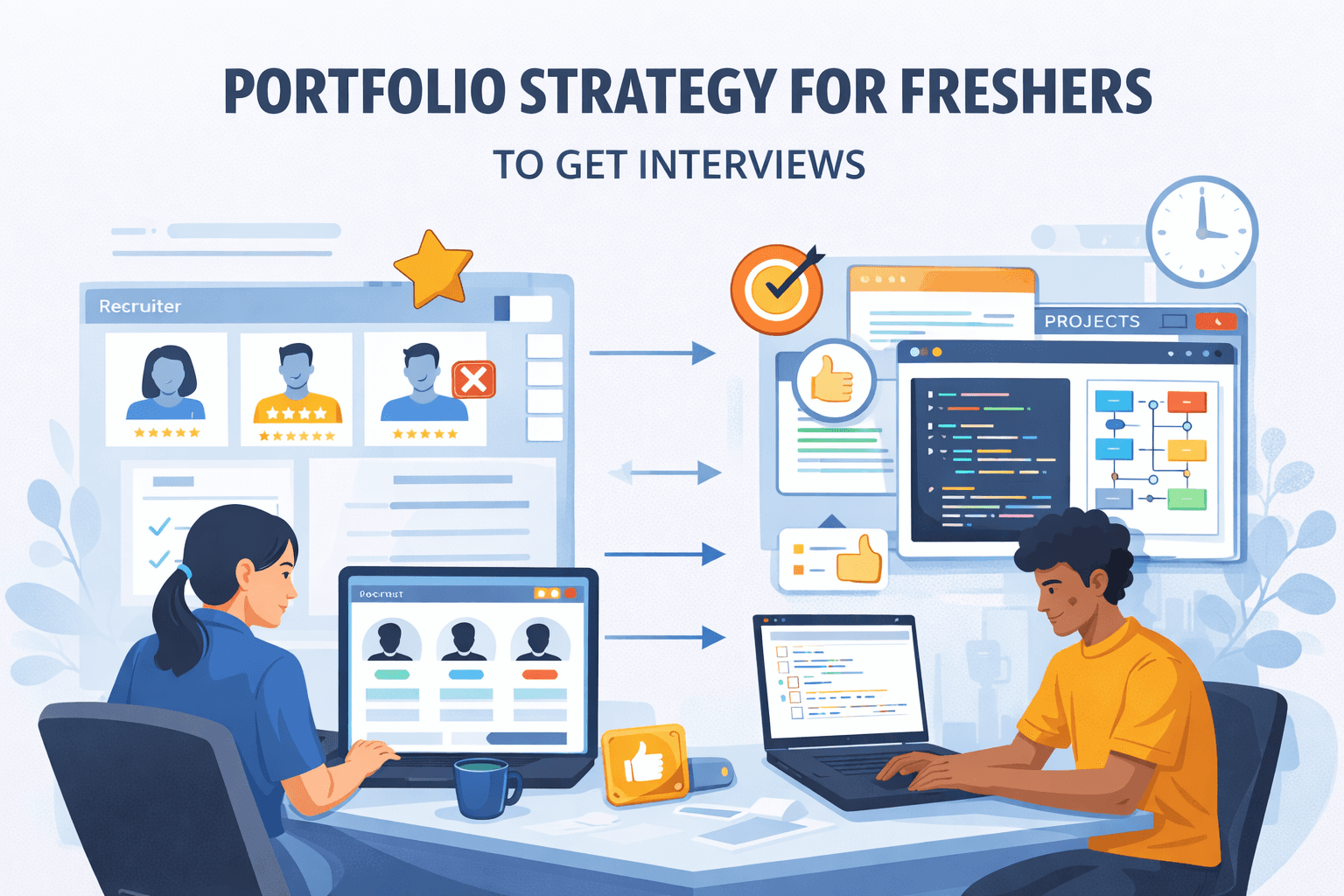
It is evident that despite being involved in various projects, fresh graduates fail to gain an interview call due to their lack of experience. Data from recruiter feedback indicates that many candidates present similar project types, which reduces differentiation during screening. While project count remains high, hiring managers report that portfolio structure and relevance determine shortlist decisions.
Posts from developers and hiring managers on social networking sites indicate that portfolios do not contain sufficient information in terms of defining the problem statement or discussing the technology used in detail. The above discussion leads to the conclusion that the problem does not lie in putting in hard work, but rather in the approach taken for portfolios by freshers to showcase their projects.
Recruiter Feedback Points to Repetitive Project Patterns
Recruiters at all levels have said that portfolios contain similar applications such as CRUD applications, weather dashboard apps, and clones. This trend has been noticed several times during the hiring process when people mention that repetition is making it hard to assess one’s abilities. As a result, candidates with similar project lists receive limited attention.

Tweets from developers and hiring managers also reflect this trend. Several posts mention that portfolios fail to demonstrate independent thinking or problem-solving. Instead, they replicate tutorial content without modification. These observations suggest that a weak portfolio strategy for freshers reduces visibility during initial screening.
Technical Depth and Real-World Context Influence Shortlisting
From the conversations regarding hiring, it is clear that companies prefer candidates who have experience working on projects that emulate real-life systems like those having authentication, API, database, and error handling components.
System Design Signals Improve Evaluation
It is also seen by engineering leaders that commit history and folder structure affect the assessment process. Well-disciplined development can be identified through regular commits, proper commit messages, and proper folder structure. Such signs enable the hiring managers to determine the candidate’s attitude towards projects over time.
Portfolios that do not include any explanation of system designs are less considered. Portfolios where there is no description of architectures are viewed as incomplete portfolios despite being well-functional projects.
Community Discussions Highlight Portfolio Structuring Gaps
Discussion among developers reveals that most of the candidates concentrate on development of projects but pay little attention to presentations. Multiple discussion threads confirm that portfolios usually lack clear explanations of projects like definitions of problems, solution techniques, and reasons behind technical decisions.

Posts from professionals in the industry highlight the importance of clear representation. Many posts point out that recruiters spend minimal time on every portfolio considered. Without proper representations, the process gets immediately terminated.
Lack of Role Alignment Reduces Visibility
Another common trend is that there is no match between the role and content. The portfolios have a blend of different projects without any focus on certain roles. There is low relevance when it comes to screening the portfolios.
Shift Toward Quality-Focused Portfolio Strategy for Freshers
The current hiring pattern shows a tendency towards projects that are fewer in number but more elaborate. Recruiters find it easier to engage with projects that showcase two or three full-fledged systems rather than several unfinished ones. Such projects generally involve demonstration, documentation, and an explanation of the technical details.
Community perspectives further reveal that deployment is a part of the evaluation process. Deployed projects help recruiters interact with them directly to assess their functional capabilities.

Final Thoughts
As the criteria for hiring changes, the portfolio approach for freshers remains a determinant of interview success. Presentation, technical knowledge, and applicability to job profiles remain constant across feedback from recruiters and community forums.