
Autonomous Agents for Beginners: Build Your First AI Agent
Learn autonomous agents for beginners and build your first AI agent without a machine learning background using simple tools and workflows.
Rising Interest in Autonomous Agents Across Web3 Development
The interest in Autonomous Agents for Beginners keeps increasing as programmers come up with more creative means of automating decision-making processes within blockchains. Discussions across developer communities and shared resources indicate that more career switchers now engage with agent-based systems, especially those linked to Web3 smart contracts and DeFi workflows.
Sources from open developer forums and documentation platforms such as LangChain show increased activity around agent frameworks. These frameworks allow users to connect language models with external tools, enabling task execution without manual intervention. At the same time, public posts from contributors on X (Twitter) show growing experimentation with lightweight agent setups that require no prior machine learning experience.
Some developers have tweeted about working prototype bots that perform price monitoring and conditional transactions with smart contracts. In this case, we can see more emphasis on integration of the API together with logic loops and not modeling from scratch.
How Autonomous Agents Operate Without Machine Learning Backgrounds
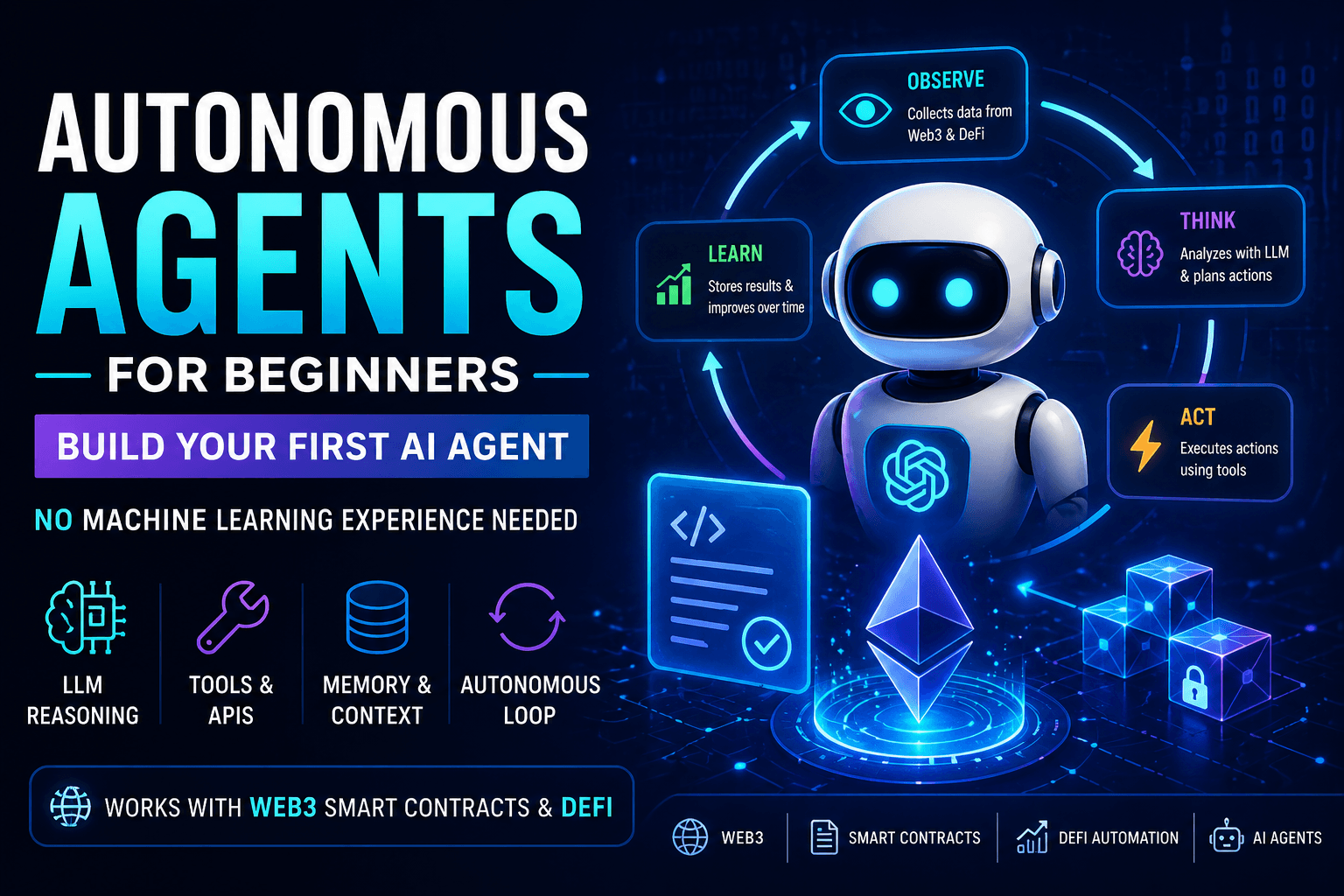
Autonomous systems used in Autonomous Agents for Beginners rely on structured workflows instead of model training. These systems combine pre-trained language models with programmable actions. As a result, developers can build applications using existing infrastructure.

The core system includes a reasoning layer powered by APIs such as those from OpenAI. This layer interprets the commands and produces the output. Tool layer interacts with other external applications, such as blockchain node and DeFi application. The control loop controls the process of execution, indicating when to retrieve data and when to perform particular action based on the analysis.

For instance, in Web3 smart contracts, the agent retrieves on-chain data and performs an action upon reaching predefined thresholds. An example of that would be monitoring the liquidity pools within the DeFi protocol. It requires well-designed prompt and well-built tools but not machine learning knowledge.
Use Cases Connecting Autonomous Agents With DeFi Systems
Researchers trying out Autonomous Agents for Beginners usually tend to use these agents to automate financial operations in DeFi protocols. Public repositories have agents that perform activities like monitoring tokens, performing trades, and optimizing portfolio positions.

Agents used in DeFi applications directly interface with smart contracts. It is possible for agents to retrieve information from the blockchain, check for conditions for transactions, and perform actions through linked wallets. This allows the process of automating certain repetitive activities such as yield farming and arbitrage.
Examples of agents developed by independent researchers who tweet about their work include agents interfacing with decentralized exchanges. These agents analyze price feeds and make swaps under certain pre-defined conditions. These agents utilize modular architectures, which makes implementation easy.
Challenges Observed in Early Autonomous Agent Implementations
Even though its usage is expanding, developers involved in Autonomous Agents for Beginners highlight various problems that they have encountered. For instance, shared forums mention execution problems related to agents using multiple APIs.
The other issue that is common is that of inconsistency. Inconsistency occurs if agents receive different responses because the commands provided by them were not structured properly. In this regard, developers work on improving the prompts used and reducing ambiguity.
Security issues are another problem that arises while implementing autonomous agents within DeFi. Agents that connect to Web3 smart contracts need proper security mechanisms since their actions might cause them to perform unwanted activities. Because of this, developers normally put their agents through tests before putting them into production.
Final Thoughts
The increasing engagement of Autonomous Agents for Beginners demonstrates a trend towards actual implementation of AI in Web3 systems. The focus is on experimenting with autonomous agents interacting with Web3 smart contracts and decentralized finance using specific processes instead of model training.
Tools already available, as well as implemented solutions, suggest that barriers to getting started have been reduced for people making a career change. Using appropriate experimentation and setting up a system, one can create agents performing certain actions such as analyzing, executing, or monitoring.