
How AI Agents in DeFi Are Changing Trading in 2026
AI Agents in DeFi are transforming crypto trading in 2026 through automated trading, cross-chain execution, and smart contract automation.
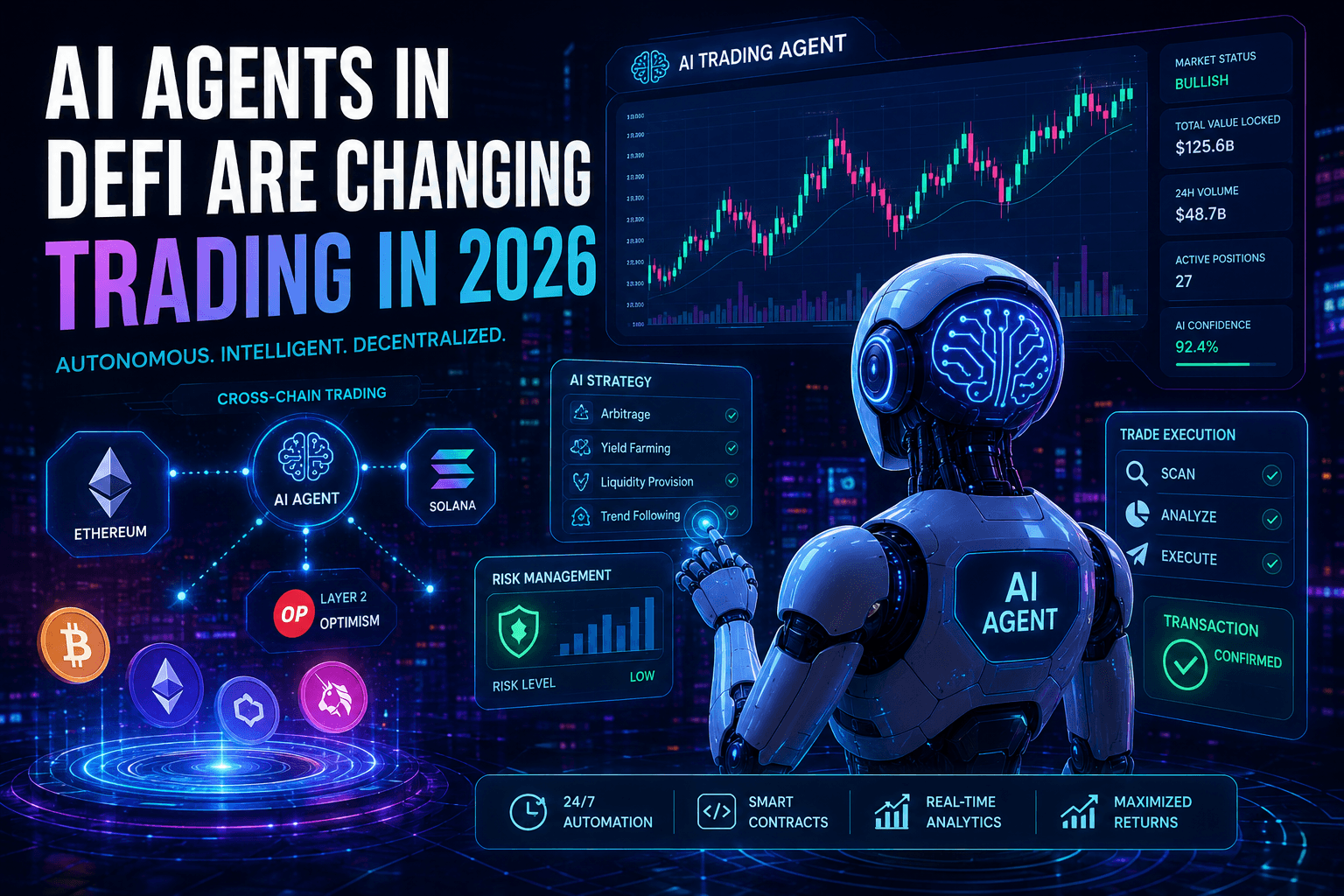
AI agents in DeFi will become even more common in the cryptocurrency market environment by 2026 since exchanges, developers, and DeFi platforms start applying automation solutions to manage the processes occurring in the market. It is necessary to note that several blockchain analytics firms, as well as DeFi developers, observed a high percentage of AI trading solutions implementation to automate portfolio and liquidity management and on-chain markets’ analysis.
It happened due to the fact that modern DeFi platforms handle huge amounts of transaction volume. The tasks that had been performed manually before have started to be executed with the help of AI solutions capable of yield optimizations, arbitrage analysis, and risk monitoring. Additionally, autonomous agents are designed in order to operate smart contracts without human intervention.
How AI Agents in DeFi Are Automating Trading
AI agents in DeFi leverage machine learning algorithms, predictive analytics, and blockchain data feeds to trade independently. The algorithms constantly monitor decentralized exchanges, lending platforms, and liquidity pools. Once they identify the pre-defined trading criteria, an AI trading agent is able to execute the transaction through smart contracts.

Numerous decentralized finance platforms employ AI-enabled trading agents that analyze wallet behavior, token volatility, and liquidity positions. Some of these trading agents also analyze protocol upgrades and market sentiments from social media platforms to generate trading signals. According to the software developers, such techniques minimize trade execution times during periods of increased market activity.
Autonomous agents of DeFi also enable cross-chain trades. Such bots interact with bridges and decentralized exchanges in Ethereum, Solana, and Layer 2 protocols. In doing so, users can transfer their funds between various blockchains without having to initiate any trade separately. Various companies have provided APIs to support the technology.

Some developers talked about these technologies on X, formerly Twitter, back in the first quarter of 2026. They included the issues of reinforcement learning approaches, automated treasury management, and agent interactions in DApps.
Why AI-Powered DeFi Systems Are Expanding
The development of AI agents in DeFi is driven by rising demand for automated trading platforms within the cryptocurrency space. Trading takes place continuously in DeFi markets, thus preventing numerous people from actively observing them manually. With AI technology, protocols become able to analyze the trading activity constantly.
AI-powered models were shown to be more efficient by blockchain scientists. While previous trading bots worked using a predefined set of actions, today’s models change their approaches depending on current market behavior, patterns of previous trading sessions, and liquidity.
Yield Farming Automation is being tried out by various DeFi projects too. The yield farming software is used to move money across different lending protocols based on changes in interest and liquidity rates. Some AI applications can reallocate funds in portfolios within seconds when changes occur in market dynamics.
Service providers in the field of artificial intelligence continue to expand their services to decentralized applications. Services such as cloud inference engines, GPU networks on blockchain platforms, and tools for blockchain validation are some features provided by some of the DeFi platforms. Developers emphasize that cheaper infrastructure services contributed to fast AI adoption.
Risks and Technical Challenges Facing AI Agents in DeFi
However, despite their increasing use of Ai agents in DeFi, there are a variety of operational and security challenges faced by AI agents in finance. One of the main challenges is smart contract vulnerabilities. In case an AI agent comes into contact with vulnerable smart contracts, it would lead to higher exposure to losses.
Also, there are fears expressed by developers about transparency issues with AI trading bots. Some models used by AI agents when trading rely on proprietary algorithms that make it hard for traders to evaluate trading models. Security researchers are continuing to look out for risks related to manipulation of market signals and incorrect predictions.

Another factor to consider when using AI in decentralized finance systems is the network congestion. Due to network traffic, transactions could be delayed due to increased gas fees especially on the Ethereum network as well as Layer 2 networks.
Also, the issue of regulations of AI agents is gaining momentum. Regulatory bodies from different parts of the world are investigating whether or not AI-powered DeFi platforms need extra scrutiny. Nevertheless, majority of decentralized platforms operate without any form of centralized control.
The Future of Autonomous AI Trading Systems
Web3 developers are still developing more sophisticated AI agents in DeFi. In current academic research, there is an emphasis on coordinating multiple AI agents, decentralized AI models, and autonomous trading systems. There are some projects working on AI entities that could trade liquidity independently of any decentralization platforms.

According to specialists, DeFi systems that work autonomously will remain a popular direction in blockchain for many years to come until at least 2026. In parallel with the technology, more elements will become automated.